Key facts at a glance
- Foreign children living in Korea can attend public elementary and middle school free, and since 2021 high school admission fees, tuition and textbooks are free at most schools.
- TOPIK runs 15 times a year in Korea (6 paper, 6 internet-based IBT and 3 speaking tests), and TOPIK scores are valid for 2 years.
- In 2026, TOPIK in Korea costs ₩40,000 (TOPIK I) and ₩55,000 (TOPIK II) on paper, ₩70,000/₩95,000 for the IBT, and ₩80,000 for TOPIK Speaking.
- Korea's KIIP (사회통합프로그램) runs from Level 0 to Level 5 (about 485 hours); completing it or passing its permanent-residence test is required for most F-5 applications.
- In Korea's KIIP, a valid TOPIK certificate gives direct placement: TOPIK 1 to Level 2, TOPIK 2 to Level 3, TOPIK 3 to Level 4, and TOPIK 4 to 6 to Level 5.
- Korea's GKS scholarship pays airfare, tuition (NIIED up to ₩5M per semester) and an all-inclusive allowance of ₩16.56M a year for graduate degree students (2026).
- GKS applicants for Korea must be under 25 (undergraduate) or under 40 (graduate); graduate applications open around February and undergraduate ones around September.
Quick links: Study in Korea portal · TOPIK registration · KIIP registration · GKS Scholarship · Seoul Education Call Center: 02-1396
Table of Contents
- Overview: Education in Korea for Foreigners
- Enrolling Children in Korean Public Schools
- International Schools & Foreign Schools in Korea
- Kindergarten & Early Childhood Education
- After-School Activities & Hagwons (학원)
- Learning Korean: Apps, Classes & Programmes
- TOPIK: The Korean Language Proficiency Test
- KIIP: Korea Immigration & Integration Programme
- University Admission for Foreign Students
- GKS: The Global Korea Scholarship
- Online Learning Resources in English
- Education for Multicultural Families
- Glossary of Korean Education Terms
1. Overview: Education in Korea for Foreigners
Korea places enormous cultural value on education — it is central to social identity, career advancement, and family life. The educational system is renowned for producing high academic achievement, consistently placing near the top of international rankings such as PISA. At the same time, it is famously competitive and high-pressure, particularly at the high school and university entrance levels.
For foreign residents, Korea's education landscape offers both challenges and genuine opportunities:
- Foreign children can enrol in Korean public schools for free, but face a Korean-language learning curve
- Well-funded international and foreign schools serve the expat community at a cost
- Free Korean language programmes (KIIP, sejong institutes) are widely available and genuinely useful for building long-term roots
- Korean universities actively recruit international students and offer English-taught degree programmes
- The GKS scholarship provides fully funded university study for eligible foreign nationals
2. Enrolling Children in Korean Public Schools
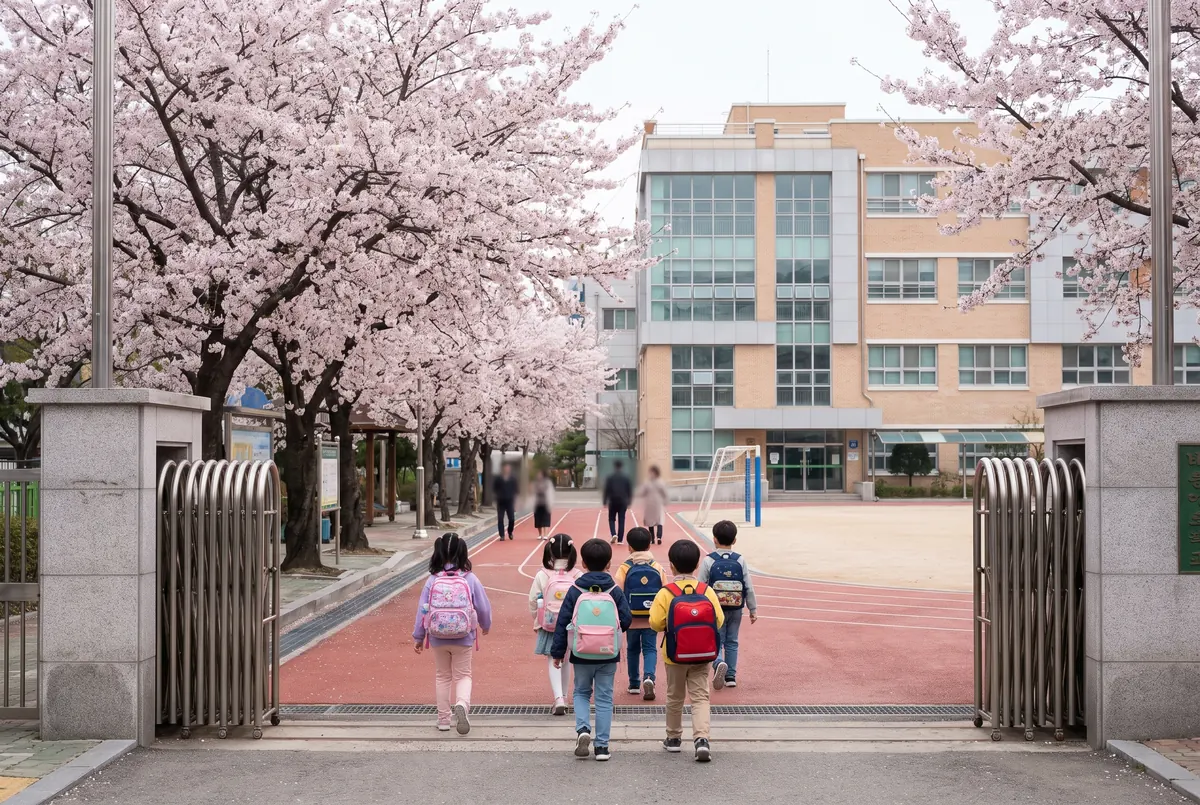
Foreign children have the legal right to attend Korean public schools at no tuition cost. Elementary and middle school are compulsory and free for all, including foreign children residing in Korea.
How the Korean School System Works
| Level | Korean Name | Duration | Age Range |
|---|---|---|---|
| Elementary school | 초등학교 | 6 years | Ages 7–12 |
| Middle school | 중학교 | 3 years | Ages 13–15 |
| High school | 고등학교 | 3 years | Ages 16–18 |
| University | 대학교 | 4 years (standard) | Ages 19+ |
Elementary and middle school are free and compulsory. High school is not compulsory, but since 2021 admission fees, tuition, school operation fees and textbooks have been free at most public and private high schools (a few private schools, such as autonomous private high schools, may still charge). University is self-funded or scholarship-supported.
Enrollment Process for Foreign Children
Step 1: Check your district
Contact the Office of Education for your local district (교육청) to find out which school serves your address. In Seoul, call the Seoul Education Call Center at 02-1396. Each city and province has its own education office.
Step 2: Gather documents
- Child's passport and ARC (or proof of address if ARC is pending)
- Parent's ARC
- Proof of address (lease agreement, utility bill)
- Previous school records — translated into Korean where possible, though not always mandatory at the elementary level
Step 3: Visit the school
Go to the local school in person. Schools are required to accept foreign children and cannot refuse enrollment on the basis of not speaking Korean. An interpreter or bilingual friend is helpful for the initial meeting.
Step 4: Support for Korean language learning
Schools with significant foreign student populations often have multicultural education programmes and Korean language support classes. Dedicated multicultural preparatory schools (다문화예비학교) provide intensive Korean language and cultural orientation before mainstream classroom integration.
What to Expect
The Korean classroom culture is notably different from Western schools:
- Emphasis on memorisation and exam performance — particularly intensifies in middle and high school
- Long school hours — elementary school typically runs 8:30 AM–2:00 PM, but many students attend hagwons (private academies) in the afternoon until 9–10 PM
- Collective culture — class cohesion and group activities are important; individual standout behaviour is less encouraged than in many Western systems
- Homework load — significant from around 3rd grade onward
- Language barrier — a foreign child with no Korean may struggle initially, but children tend to acquire language much faster than adults; most reach functional fluency within 1–2 years
School Lunch (급식)
Korean public school lunches are cafeteria-style and included in school fees (a small monthly charge). Meals are generally nutritious and Korean in style — rice, soup, side dishes. Children with severe food allergies should communicate this to the school in advance; accommodations are limited but possible.
3. International Schools & Foreign Schools in Korea
For families who want English-medium or other foreign-language education, Korea has a growing network of international and foreign schools.
The Two Key Categories
Foreign Schools (외국인학교):
These are legally established under the Elementary and Secondary Education Act specifically for children of foreign residents. They must maintain at least 70% foreign student enrollment. They typically offer American, British, IB, or other international curricula in English or other foreign languages.
International Schools (국제학교):
Often located in Free Economic Zones (FEZ) or special districts. They may admit more Korean students and may issue a Korean high school diploma alongside an international diploma.
Eligibility
To enrol in a foreign school, your child must meet at least one of these criteria:
- At least one parent holds a non-Korean passport
- Child has attended school abroad for at least six full semesters (3 years)
- Child is a Korean citizen who has resided outside Korea for at least 1,095 days (3 years)
Note on dual nationals: Under Korean nationality law, a child with any Korean parentage may be considered Korean by Korean authorities even if they hold another country's passport. This can affect foreign school eligibility — confirm directly with the school.
Major International/Foreign Schools in Korea
Seoul:
| School | Curriculum | Est. Annual Tuition |
|---|---|---|
| Seoul Foreign School (SFS) | British national curriculum + IGCSE/A-Level | ₩30–45M |
| Seoul International School (SIS) | American AP | ₩35–45M |
| Korea International School (KIS) | American IB | ₩35–50M |
| Korea Foreign School | IB | ₩30–45M |
| Yongsan International School of Seoul | American | ₩25–35M |
Outside Seoul:
| School | Location | Curriculum |
|---|---|---|
| Busan International Foreign School (BIFS) | Busan | American |
| Daejeon Christian International School | Daejeon | American |
| TAEJON Christian International School (TCIS) | Daejeon | American/IB |
| Jeju International School (JIS) | Jeju | American/IB |
| North London Collegiate School Jeju | Jeju (JGEC) | British |
Annual tuition ranges from approximately ₩20–60 million (USD 15,000–45,000) per year, depending on the school and grade level. Additional fees for activities, transport, and facilities are common.
Application Process
- Rolling admissions at most schools for elementary and middle levels; high school typically requires semester-start entry
- Apply at least 1 month in advance of intended start date
- Required documents: passport copies for child and parents, ARC copies, previous school transcripts (original + English translation), teacher recommendation letter (for older grades)
- Most schools require a placement assessment for grade determination and to identify English Language Learner (ELL) support needs
- Application fee: ₩200,000–₩500,000 (non-refundable)
Diploma Recognition
Foreign schools do not issue Korean high school diplomas. If a student educated at a foreign school wishes to apply to a Korean university through the standard admissions route, they will need to take the Korean High School Equivalency Exam (검정고시). International schools in FEZ zones may offer a combined Korean diploma alongside the international curriculum.
4. Kindergarten & Early Childhood Education
Korean Public Kindergartens (공립유치원)
Public kindergartens are attached to elementary schools. Tuition is heavily subsidised — families pay only lunch fees and materials costs. Places are allocated by lottery and are in high demand; apply early.
Age range: Typically ages 3–5 (만 나이 / international age — the official standard since June 2023).
Private Kindergartens (사립유치원)
More numerous than public kindergartens, with varying philosophies (play-based, academic, international, bilingual). Quality ranges widely. Monthly tuition typically ₩300,000–₩700,000 plus meals.
English-Medium Kindergartens
Many private kindergartens offer bilingual (Korean-English) programmes. These are popular among expat families and Korean families seeking early English exposure. The government does not subsidise English-medium instruction, so costs are higher.
The Nuri Curriculum (누리과정)
Korea's national early childhood education curriculum covers ages 3–5 (만 나이 / international age). It emphasizes play-based learning, basic literacy, and social development. All licensed kindergartens — public and private — are required to follow it, though private kindergartens may supplement with additional programmes.
Daycare (어린이집)
For children below kindergarten age (roughly ages 0–2 under the 만 나이 system), daycare centres (어린이집) are the primary option. The government provides vouchers (paid through the 국민행복카드 — National Happiness Card, which absorbed the old 아이행복카드 in April 2021) that cover most or all daycare costs for eligible families. Foreign families with ARC and NHIS enrollment may qualify.
5. After-School Activities & Hagwons (학원)
What is a Hagwon?
A hagwon (학원) is a private educational institute — essentially a cram school or after-school academy. They are a defining feature of Korean education culture. Almost every subject is covered: English, math, science, coding, music, art, taekwondo, swimming, and more.
Hagwons typically operate in the afternoon and evening, often running until 10 PM on weekdays. Many Korean children attend 2–4 different hagwons per week in addition to school.
For Foreign Children
Hagwons can be a great way for foreign children to:
- Learn Korean in a structured, social environment
- Meet Korean peers outside school
- Develop skills in areas they are already strong in (music, sports) without the language barrier being as significant
For Foreign Adults Learning Korean
Korean language hagwons are one of the most popular and effective ways to learn Korean. University district areas (Sinchon, Hongdae, Gangnam) have dozens of options.
What to look for:
- Small class sizes (5–10 students ideal)
- Clear curriculum level system aligned with TOPIK levels
- Native Korean teachers with teaching experience
- Flexible scheduling — morning, afternoon, and evening options exist
Popular language hagwons: Yonsei Korean Language Institute, Seoul National University Language Education Institute, Sogang Korean Program, and many private schools.
Typical cost: ₩200,000–₩500,000 per month for group classes; ₩50,000–₩100,000 per hour for private one-on-one tuition.
6. Learning Korean: Apps, Classes & Programmes
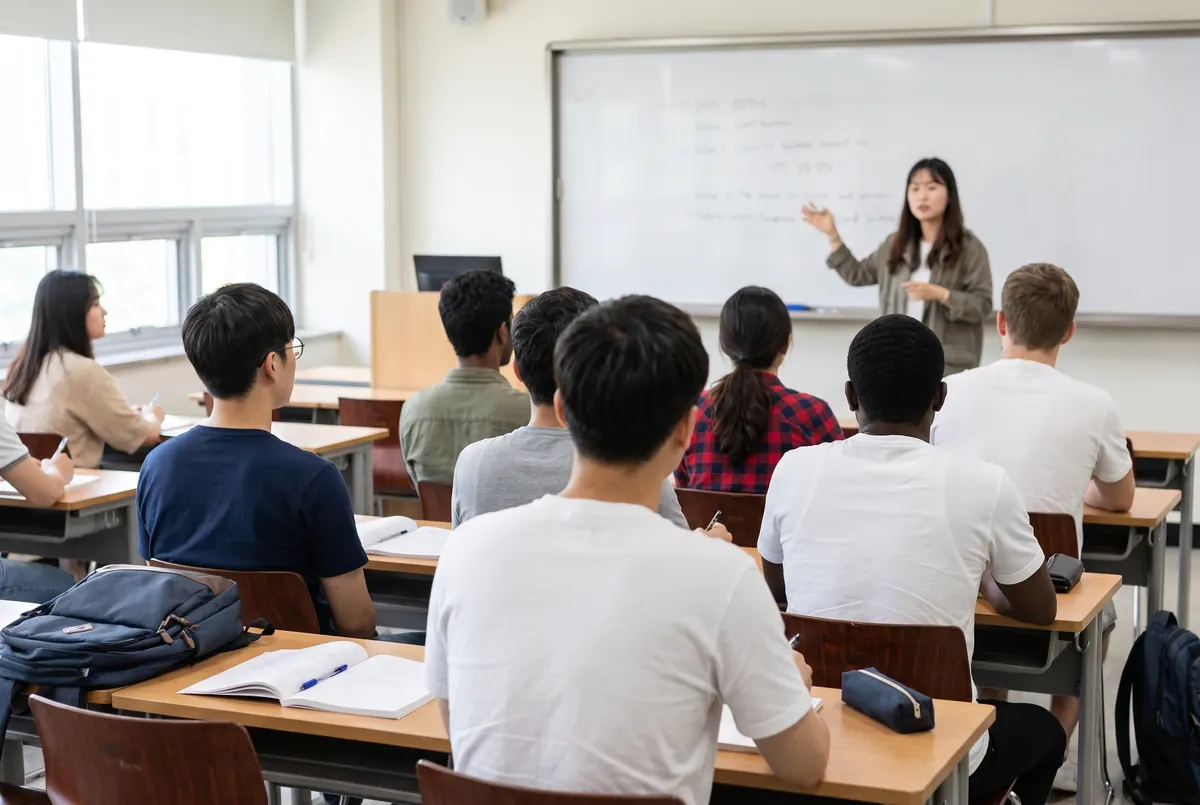
Why Learn Korean?
Even basic Korean transforms daily life in Korea. It opens access to:
- A vastly wider range of jobs and professional opportunities
- Stronger visa options (KIIP completion and TOPIK scores directly affect F-2-7 points and F-5 eligibility)
- Genuine social connections with Korean people
- Navigation of government services, healthcare, and daily errands without depending on others
Free Resources
Apps:
- Duolingo — good for absolute beginners to build basic vocabulary; gamified structure
- LingoDeer — stronger grammar structure than Duolingo; designed for Asian languages
- Pimsleur — audio-focused; good for speaking and pronunciation
- Anki — flashcard system for vocabulary; highly customizable with community Korean decks
- TOPIK One — practice tests specifically for TOPIK exam preparation
YouTube Channels:
- Talk To Me In Korean (TTMIK) — the most comprehensive free Korean learning resource; covers all levels; also has paid courses and textbooks
- Korean Unnie — beginner-friendly lessons with a warm teaching style
- Professor Oh's Korean Language — clear grammar explanations
- KBS World Korean — authentic Korean listening practice
Websites:
- Talk To Me In Korean (talktomeinkorean.com) — free lessons, textbooks, and courses
- How to Study Korean (howtostudykorean.com) — comprehensive free grammar guide
- TTMIK Vocabulary Builder — free word lists by category
University Language Programmes
Major Korean universities operate intensive Korean language programmes open to all foreigners:
| Programme | University | Duration Options | Cost (Approx.) |
|---|---|---|---|
| Yonsei Korean Language Institute | Yonsei University, Seoul | 10 weeks per level | ₩1,860,000 (2026; ₩1,960,000 from 2027) |
| Seoul National University Language Education Institute | SNU, Seoul | 10 weeks | ₩1,200,000–₩1,500,000 |
| Sogang Korean Program | Sogang University, Seoul | 8 weeks | ₩1,200,000 |
| Korea University Korean Language Center | Korea University, Seoul | 10 weeks | ₩1,200,000 |
These programmes typically run 4 hours per day, 5 days per week, and move through TOPIK-aligned levels (1 through 6). They require a D-4 visa for non-ARC holders; ARC holders can attend on their existing visa.
King Sejong Institute (세종학당)
The Korean government operates King Sejong Institutes (세종학당) worldwide and within Korea. These offer affordable Korean language and culture courses:
- Free or subsidised courses in many locations
- In Korea, located in community centres, cultural centres, and some universities
- Open to anyone — no enrollment restrictions
- Find your nearest institute at ksif.or.kr (King Sejong Institute Foundation)
7. TOPIK: The Korean Language Proficiency Test
TOPIK (Test of Proficiency in Korean / 한국어능력시험) is the official, internationally recognized Korean language proficiency certificate. It is essential for:
- University admission in Korea (most universities require TOPIK Level 3–4)
- Visa applications (KIIP results or TOPIK score is required for F-2-7 and F-5 visas)
- Employment at Korean companies (many require TOPIK Level 3+)
- F-2-7 visa points system: TOPIK Level 6 or KIIP Level 5 gives maximum language score
TOPIK Structure
| Exam | Levels Covered | Components | Test Duration |
|---|---|---|---|
| TOPIK I | Levels 1–2 (Beginner) | Listening (30 q) + Reading (40 q) | 100 minutes total |
| TOPIK II | Levels 3–6 (Intermediate–Advanced) | Listening (50 q) + Reading (50 q) + Writing (4 q) | 180 minutes total |
| TOPIK Speaking | Speaking ability | Short oral responses | ~30 minutes |
TOPIK Levels Explained
| Level | Description | Approximate CEFR Equivalent |
|---|---|---|
| Level 1 | Survival Korean — greetings, shopping, basic conversation | A1 |
| Level 2 | Functional daily life — using public services, simple descriptions | A2 |
| Level 3 | Basic social and professional contexts | B1 |
| Level 4 | Wide range of topics; some formal language | B1–B2 |
| Level 5 | Nuanced social and professional language; can read news | B2–C1 |
| Level 6 | Near-native fluency; complex academic and professional use | C1–C2 |
Passing Scores
| Exam | Level | Minimum Score Required |
|---|---|---|
| TOPIK I | Level 1 | 80 out of 200 |
| TOPIK I | Level 2 | 140 out of 200 |
| TOPIK II | Level 3 | 120 out of 300 |
| TOPIK II | Level 4 | 150 out of 300 |
| TOPIK II | Level 5 | 190 out of 300 |
| TOPIK II | Level 6 | 230 out of 300 |
Test Schedule (2025–2026)
TOPIK PBT (Paper-Based Test) is held 6 times per year in Korea: January, April, May, July, October, and November.
TOPIK IBT (Internet-Based Test) is held 6 times per year in Korea (in 2026: February, March, June, September, October and November), and the separate TOPIK Speaking test 3 times a year (March, June and October).
Test spots fill quickly — register as soon as registration opens (typically 2 months before the test date) at topik.go.kr.
Registration fees (in Korea):
- TOPIK I: ₩40,000 (IBT: ₩70,000)
- TOPIK II: ₩55,000 (IBT: ₩95,000)
- TOPIK Speaking: ₩80,000
How to Prepare
- Download past papers — free on the official TOPIK website; practising these is the single most effective preparation
- TOPIK Guide (topikguide.com) — mock tests, grammar explanations, study packs
- Talk To Me In Korean — structured curriculum aligned with TOPIK levels
- University language programmes — structured classes specifically covering TOPIK content
- Anki decks — essential vocabulary lists for each TOPIK level are freely available online
8. KIIP: Korea Immigration & Integration Programme
KIIP (Korea Immigration and Integration Programme / 사회통합프로그램) is a free government programme offering Korean language and cultural education to foreign residents. Unlike TOPIK (an exam), KIIP is a multi-level course you take over time.
KIIP is arguably the most important educational programme for long-term foreign residents because:
- Completing Level 5 gives the maximum language score on the F-2-7 visa points system
- Level 5 completion is required for most F-5 permanent residency applications (or passing a specific permanent residency exam)
- Courses are free — the government subsidises all instruction
- Classes are held at community centres, universities, and multi-cultural centres across Korea
KIIP Levels
| Level | Korean Content | Duration |
|---|---|---|
| Preliminary | Hangul basics, pronunciation | 15 hours |
| Level 1 | Basic daily language | 100 hours |
| Level 2 | Intermediate daily communication | 100 hours |
| Level 3 | Social integration — workplace, community | 100 hours |
| Level 4 | Advanced communication — culture, society | 100 hours |
| Level 5 | Korean society and culture — advanced integration | 70 hours (plus a 30-hour advanced course for naturalisation) |
Total time to complete all levels: approximately 485 hours to finish Level 5’s basic course (515 hours including the advanced course) (over 1–2 years for most students).
Level Placement
When you register, you take a placement test to determine which level you begin at. If you have no Korean, you start at the Preliminary level. If you have existing Korean ability, you may be placed at Level 2, 3, or higher.
Important: If you have a TOPIK score, it can be used to waive certain KIIP levels:
- TOPIK Level 1 = enter KIIP at Level 2
- TOPIK Level 2 = enter KIIP at Level 3
- TOPIK Level 4 or higher = enter KIIP at Level 5
How to Register
- Visit socinet.go.kr to register
- Apply for the pre-assessment (placement test) and sit it at the venue designated by your immigration office — TOPIK holders can skip it
- Choose a class near you — morning, afternoon, and evening options available
- Attend consistently — attendance requirements apply (typically 80% minimum)
Demand is high — spots fill quickly, especially Level 5 classes and classes in Seoul. Register as soon as a new intake opens.
KIIP vs TOPIK
| KIIP | TOPIK | |
|---|---|---|
| Format | Multi-month course (attendance) | Single-day exam |
| Cost | Free | ₩40,000–₩55,000 per paper-based sitting (₩70,000–₩95,000 for IBT) |
| Output | Completion certificate by level | Score-based proficiency certificate |
| Visa relevance | F-2-7 points; F-5 requirement | F-2-7 points; university admission |
| Best for | Long-term residents building toward PR | Students, job seekers, visa applicants |
9. University Admission for Foreign Students
Korea's universities are internationally competitive and actively recruit foreign students. The admissions landscape for foreigners differs significantly from the Korean domestic system (which is dominated by the 수능 Suneung national college entrance exam).
How Foreign Students Apply
Foreign applicants typically apply through a separate international student admissions track — not through the Korean national exam. Most universities accept:
- High school transcripts (translated and notarized)
- SAT/ACT scores, IB results, A-Levels, or equivalent national qualifications
- TOPIK score (Level 3–4 typically required for Korean-taught programmes; some English-taught programmes have no TOPIK requirement)
- Personal statement / letter of motivation
- Teacher recommendations (at graduate level)
- English proficiency scores (TOEFL/IELTS — for English-taught programmes)
Key Korean Universities (SKY and beyond)
| University | Location | Ranking (QS 2026) | Notable For |
|---|---|---|---|
| Seoul National University (SNU) | Seoul | ~38 | Engineering, medicine, humanities |
| Korea University | Seoul | ~61 | Business, law |
| Yonsei University | Seoul | ~50 | Medicine, international studies |
| KAIST | Daejeon | ~53 | Science and technology |
| POSTECH | Pohang | ~102 | Engineering and sciences |
| Sungkyunkwan University | Seoul/Suwon | ~108 | Samsung-affiliated; STEM |
| Hanyang University | Seoul | ~159 | Engineering |
English-Taught Degree Programmes
Many Korean universities now offer degrees taught entirely in English. These are particularly accessible to foreign students who do not yet have strong Korean:
- SNU Graduate School of International Studies (GSIS)
- Yonsei International Campus (Songdo, Incheon)
- Korea University Business School — some international programmes
- KAIST — most graduate programmes available in English
- POSTECH — science and engineering in English
Search studyinkorea.go.kr for a comprehensive database of English-taught programmes at accredited Korean universities.
Application Timeline
| Action | Timing |
|---|---|
| Research universities and programmes | 12–18 months before intended start |
| Contact admissions offices directly | 9–12 months before |
| Prepare documents (translations, apostilles) | 6–9 months before |
| Apply (most Korean universities) | September–November for March intake; March–May for September intake |
| Visa application (D-2) | After receiving acceptance letter |
| Arrive in Korea, register at immigration | No later than 2 weeks before semester start |
Tuition Fees (International Students)
Tuition varies significantly by university, programme, and level:
- Undergraduate: approximately ₩3,000,000–₩7,000,000 per semester
- Graduate: approximately ₩2,500,000–₩6,000,000 per semester
- Medical and engineering programmes are generally higher
10. GKS: The Global Korea Scholarship (Government Full Scholarship)
The Global Korea Scholarship (GKS) — formerly known as KGSP — is the Korean government's flagship fully funded scholarship for international students. It is administered by the National Institute for International Education (NIIED).
What GKS Covers
- Economy-class airfare to Korea
- All-inclusive monthly allowance that also covers housing, health insurance and settlement costs: ₩16.56 million a year (about ₩1.38 million a month) for graduate degree students and ₩14.4 million a year (about ₩1.2 million a month) for undergraduates (2026–2027 guidelines; slightly less during the Korean language year)
- Tuition (NIIED pays up to ₩5 million per semester; the host university covers the rest and the admission fee)
- 1-year Korean language training (mandatory unless you already hold TOPIK level 5 or 6; fees covered)
- The former separate settlement, research, medical insurance and dissertation-printing payments are no longer listed — they are folded into the monthly allowance
GKS Programmes
| Programme | Duration | Degree |
|---|---|---|
| Undergraduate | 5–7 years (1 year Korean language + 4–6 years degree) | Bachelor's |
| Graduate (Master's) | 3 years (1 year Korean language + 2 years coursework) | Master's |
| Graduate (Doctoral) | 4 years (1 year Korean language + 3 years) | PhD |
| Research | ~1 year | Research grant |
Eligibility Requirements
- You and both your parents must be non-Korean citizens (no Korean nationality, no dual nationality with Korea)
- Age: Under 25 for undergraduate; under 40 for graduate
- GPA: Minimum 80% (or equivalent) from previous degree
- Health: Physically and mentally able to complete the programme in Korea
- Previous GKS: Cannot have previously received a Korean government scholarship for a degree
Application Tracks
Embassy Track: Apply through the Korean embassy in your home country. You may apply to up to 3 universities (at least 1 must be a "Type B" regional university). National competition — each country has a quota. Timing: around February for graduate programmes (GKS-G) and September for undergraduate programmes (GKS-U).
University Track: Apply directly to one Korean university participating in the GKS programme. Simpler process; the university manages initial selection. Timing: February–March for graduate programmes and September–November for undergraduate programmes.
Selection Bonus Points
- TOPIK Level 3 or above: +10% of total allocated points for graduate applicants; +3% (Level 3) to +5% (Level 5–6) for undergraduate applicants
- Korean War veteran descendants: +10%
- Applicants to science and engineering departments: +5% (English test scores count in the language evaluation, not as bonus points)
Application Period
GKS applications open annually. Check studyinkorea.go.kr for the current year's announcement and your country's Korean embassy for country-specific deadlines and quotas.
11. Online Learning Resources in English
For foreigners based in Korea or learning about Korea remotely, the following platforms are particularly useful:
Korean Language
| Resource | Type | Best For | Cost |
|---|---|---|---|
| Talk To Me In Korean (talktomeinkorean.com) | Podcast, video, textbook | All levels; structured learning | Free + paid courses |
| How to Study Korean (howtostudykorean.com) | Written lessons | Grammar-focused learners | Free |
| Coursera / edX | MOOC | University-level Korean courses | Free to audit |
| Rosetta Stone | App | Structured immersive learning | Paid subscription |
| italki | Platform | Live tutoring with Korean teachers | Per-lesson (approx ₩15,000–₩50,000) |
Understanding Korea
| Resource | Type | Content |
|---|---|---|
| Korea Herald (koreaherald.com) | English newspaper | Current events, culture |
| Korea JoongAng Daily | English newspaper | Business, politics |
| Coursera: "Understanding Korean Politics" (Yonsei) | MOOC | Political/historical context |
| KBS World Korean | TV/podcast | Listening practice in authentic Korean |
For Parents & Families
| Resource | Notes |
|---|---|
| Seoul Global Center (global.seoul.go.kr) | Education guidance, legal help, translation |
| Korea4Expats (korea4expats.com) | Community wiki; school and family guides |
| Expat Facebook groups | City-specific groups with school recommendations |
12. Education for Multicultural Families
Korea has developed specific educational support systems for multicultural families (다문화가족) — households where at least one parent is a non-Korean national. These services go beyond standard foreign resident support.
Multicultural Family Support Centres (다문화가족지원센터)
The Korean government operates over 200 Multicultural Family Support Centres across the country. Services available include:
- Free Korean language classes for foreign spouses (more intensive than standard hagwons)
- Korean culture orientation programmes
- Childcare support and parenting education
- Translation and interpretation services
- Legal advice and counselling
- Job preparation support
Find your nearest centre at liveinkorea.kr or through your local district office (구청).
Multicultural Kindergartens
Government-designated kindergartens with special programming for children from multicultural backgrounds, including bilingual support for Korean language acquisition alongside children's native languages.
Multicultural Preparatory Schools (다문화예비학교)
Before entering a standard Korean elementary or middle school, foreign children who don't yet speak Korean can attend these preparatory programmes. They offer intensive Korean language and cultural orientation over several weeks to months, easing the transition into mainstream classrooms.
Child-Specific Korean Language Support
Schools with substantial multicultural student populations employ Korean language support teachers who work specifically with students for whom Korean is a second language. These pull-out support classes can make a significant difference in the first year of school.
13. Glossary of Korean Education Terms
| Korean | Pronunciation | English Meaning |
|---|---|---|
| 학교 | hakgyo | School (general) |
| 초등학교 | chodeung hakgyo | Elementary school (grades 1–6) |
| 중학교 | jung hakgyo | Middle school (grades 7–9) |
| 고등학교 | godeung hakgyo | High school (grades 10–12) |
| 대학교 | daehakgyo | University |
| 대학원 | daehakwon | Graduate school |
| 유치원 | yuchiwon | Kindergarten |
| 어린이집 | eorinijip | Daycare centre |
| 학원 | hagwon | Private cram school / academy |
| 교육청 | gyoyukcheong | Office of Education (district) |
| 담임 | damim | Homeroom teacher |
| 학부모 | hakbumo | Parent (in school context) |
| 급식 | geupsik | School cafeteria meal / lunch |
| 수능 | suneung | National college entrance exam |
| 입학 | iphak | School enrollment / admission |
| 한국어능력시험 | hangugeo neungnyeok siheom | Korean Language Proficiency Test (TOPIK) |
| 사회통합프로그램 | sahoe tonghap peurogeulaem | Korea Immigration Integration Programme (KIIP) |
| 세종학당 | sejong haktang | King Sejong Institute (Korean language centre) |
| 다문화가족 | damunhwa gajok | Multicultural family |
| 다문화예비학교 | damunhwa yebi hakgyo | Multicultural preparatory school |
| 외국인학교 | oegugin hakgyo | Foreign school |
| 국제학교 | gukje hakgyo | International school |
| 장학금 | janghakgeum | Scholarship |
| 등록금 | deungnokgeum | Tuition fee |
| 입학원서 | iphak wonseo | University application form |
| 자격증 | jageokcheung | Certificate / licence |
| 검정고시 | geomjeong gosi | High school equivalency exam |
Frequently asked questions
Can foreign children go to public school in Korea?
Yes. Foreign children living in Korea can enrol in public elementary and middle schools, which are free, and a school cannot refuse a child for not speaking Korean. Contact your local office of education (교육청) to find the assigned school, then bring the child's passport or ARC, proof of address and previous school records. Since 2021, high school admission fees, tuition and textbooks have also been free at most schools.
How much does the TOPIK test cost in Korea?
For tests taken in Korea in 2026, the paper-based TOPIK I costs ₩40,000 and TOPIK II costs ₩55,000. The internet-based TOPIK IBT costs ₩70,000 (I) or ₩95,000 (II), and the separate TOPIK Speaking test costs ₩80,000. You register online at topik.go.kr about two months before each test and must pay with a Korean-issued card or a virtual bank account. Scores are valid for two years.
How often is TOPIK held in Korea?
Since 2025, TOPIK has been held 15 times a year in Korea. In 2026 there are six paper-based tests (January, April, May, July, October and November), six internet-based TOPIK IBT tests (February, March, June, September, October and November) and three TOPIK Speaking tests (March, June and October). Registration opens about two months before each test and seats fill quickly, so check topik.go.kr early.
What is the KIIP program in Korea?
KIIP (Korea Immigration and Integration Program, 사회통합프로그램) is the Ministry of Justice's Korean language and society course for foreign residents. It runs from Level 0 to Level 5: 15 hours, four 100-hour levels and a 70-hour Level 5 course, plus 30 more hours for naturalisation. You apply online at socinet.go.kr and take a pre-assessment unless a TOPIK level places you directly. Most F-5 applicants must complete KIIP or pass its permanent-residence test.
How much is the GKS scholarship allowance?
Under NIIED's latest guidelines, GKS pays one all-inclusive allowance that also covers housing, health insurance and settlement costs. Graduate scholars receive ₩16.56 million a year (about ₩1.38 million a month) during their degree, ₩14.4 million in the Korean language year and ₩20.88 million in the research program. For the 2027 undergraduate intake, the amounts are ₩14.4 million (degree) and ₩13.56 million (language year). GKS also pays economy airfare and tuition.
When can I apply for the GKS scholarship?
It depends on the degree level. Graduate (GKS-G) applications open around February; the 2026 embassy track ran from 12 to 25 February. Undergraduate (GKS-U) applications open in September; the 2027 embassy track ran from 15 to 30 September 2026, and university-track deadlines run to November. Embassy-track applicants can choose up to three universities, including at least one regional Type B university. University-track applicants apply to one.
Official sources
Rules, fees and deadlines change. Confirm the details with the official source before you act.
- TOPIK – Test of Proficiency in Korean (National Institute for International Education) topik.go.kr
- Socinet – KIIP levels and hours (Ministry of Justice) socinet.go.kr
- Study in Korea – Global Korea Scholarship (GKS) studyinkorea.go.kr
- National Institute for International Education (NIIED) niied.go.kr
- Danuri – Multicultural Family Support Portal liveinkorea.kr
- King Sejong Institute Foundation ksif.or.kr
Disclaimer: Admissions requirements, tuition fees, scholarship amounts, and programme details change annually. Always verify current information directly with the relevant institution, the Ministry of Education (moe.go.kr), or the Study in Korea portal (studyinkorea.go.kr) before making decisions. TOPIK exam schedules and KIIP registration dates should be confirmed at topik.go.kr and socinet.go.kr respectively.
Last reviewed: · livinginkorea.org