Key facts at a glance
- In Korea, leases with a deposit over ₩60 million or rent over ₩300,000 a month must be reported within 30 days of signing; since June 2025, late reports are fined ₩20,000–₩300,000.
- Registered foreigners in Korea must report a new address within 15 days of moving in, at the local 주민센터, an immigration office or HiKorea online; one report covers both records.
- Korea's small-deposit protection lets Seoul tenants with deposits of ₩165 million or less recover up to ₩55 million ahead of mortgage lenders if they moved in and registered first.
- HUG jeonse deposit return guarantees in Korea cost about 0.097–0.211% of the deposit a year (rates since March 2025) and must be applied for before half the lease term has passed.
- Korea's legal cap on agent fees for residential leases is 0.3–0.6% of the transaction value, e.g. 0.5% (max ₩200,000) for leases under ₩50 million.
- Tenants in Korea can renew a lease once for 2 more years with rent or deposit increases capped at 5%; landlords must give non-renewal notice 6 to 2 months before the end date.
- Korea had over 40,900 recognised jeonse fraud victims by August 2026; check the property registry (등기부등본) at iros.go.kr on signing day and pay only the registered owner.
Quick links: Naver Real Estate · Zigbang App · Dabang App · HUG Jeonse Fraud Support Center: 1533-8119 · Housing lease reporting: your local 주민센터 (community centre)
Table of Contents
- Overview: How Korean Housing Works
- Housing Types — What You'll Encounter
- The Three Rental Structures: Jeonse, Wolse, Ban-Jeonse
- Typical Costs by City and Housing Type
- How to Find a Place: Apps, Agents & Street Hunting
- Signing the Lease: A Step-by-Step Checklist
- The Three Legal Steps That Protect Your Deposit
- Deposit Scams: How to Avoid Them
- Moving In: Utilities, Internet & Address Registration
- Your Rights as a Tenant (Housing Lease Protection Act)
- Moving Out & Getting Your Deposit Back
- Short-Term & Temporary Options
- Neighbourhood Guide: Seoul & Beyond
- Glossary of Korean Housing Terms
1. Overview: How Korean Housing Works
Korea's rental system is unlike anything most foreigners have encountered. Instead of simply paying monthly rent, tenants in Korea are expected to pay a significant upfront deposit — and the size of that deposit determines how much (if any) monthly rent they pay. The larger your deposit, the lower your monthly payments.
On top of this, Korea has its own vocabulary for building types, and most housing contracts are written entirely in Korean. Understanding both the rental structure and the housing vocabulary before you start searching will save you enormous time, stress, and potentially money.
The basics you need to know before starting:
- Every rental type involves a deposit (보증금) — even the simplest goshiwon typically asks for one month's rent upfront.
- Contracts are almost always 1–2 years. Leases shorter than 2 years are legally treated as 2-year contracts under Korean tenant protection law, unless you specifically agree otherwise.
- Most landlords require rent to be paid by Korean bank transfer. Cash payments are a red flag.
- You generally need an ARC (Alien Registration Card) before most landlords will rent to you. Some will accept a passport plus a long-term visa stamp, but ARC holders have significantly more options.
2. Housing Types — What You'll Encounter
Goshiwon (고시원)
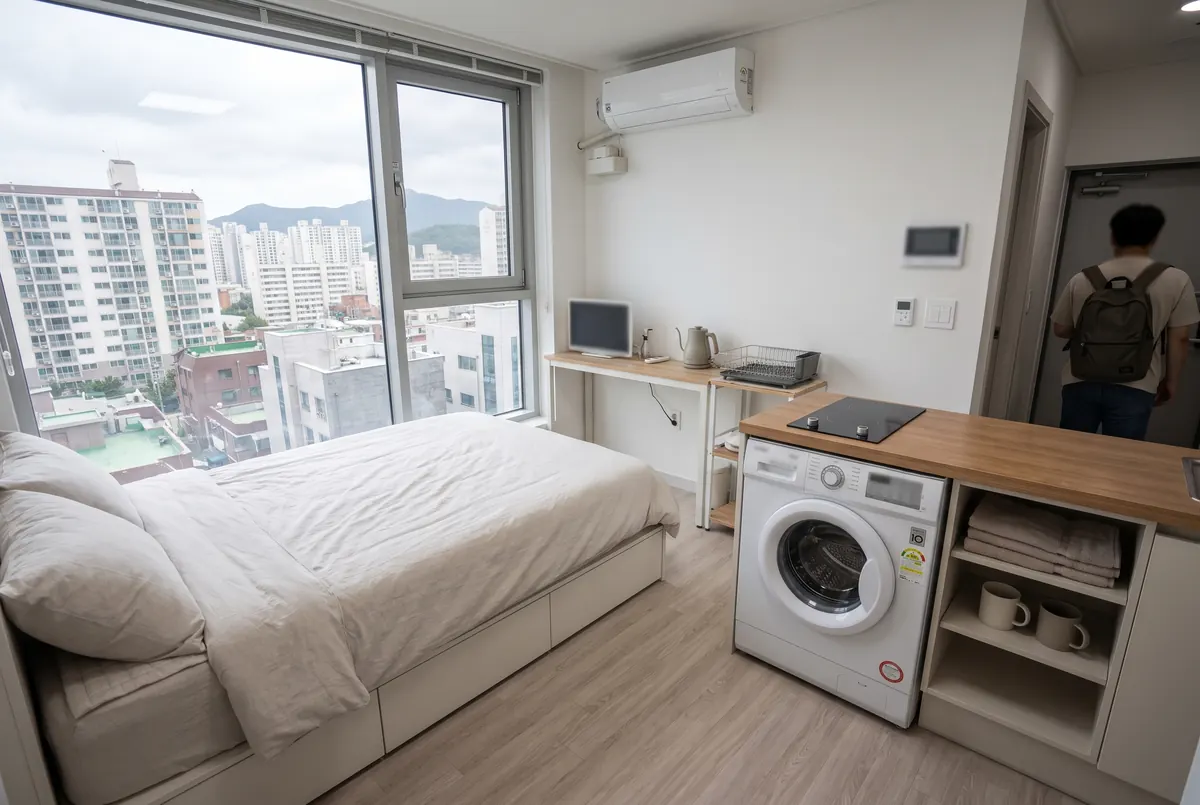
Originally designed for students preparing for exams, goshiwons are micro-rooms — typically 6–12 square metres — located in small buildings near universities or subway stations. They are Korea's most accessible housing for new arrivals.
Typical features:
- Private room with a bed, desk, wardrobe, and mini-fridge
- Private or shared bathroom (newer buildings often have private bathrooms)
- WiFi, rice, and kimchi usually included in the price
- No large deposit — usually one month's rent upfront or none at all
- Flexible stay periods — from 2 weeks to several months
Cost: ₩300,000–₩800,000/month depending on size, location, and facilities.
Best for: Arrivals without an ARC, first 1–3 months while you find long-term housing, students, budget travellers.
Watch out for: Very small rooms, thin walls, limited natural light, shared facilities. Modern "goshitels" and "one-roomtels" are essentially private studios marketed under the goshiwon name — always check actual photos and facilities.
One-Room Studio (원룸)
A one-room (원룸, won-rum) is a studio apartment inside a small residential building (usually 3–6 floors). It has its own kitchen area and bathroom. This is the most common housing type for single foreigners.
Typical features:
- Private studio with a kitchen and bathroom
- Usually comes partially furnished (bed, washing machine, sometimes fridge)
- Lease of 1–2 years standard
- Requires a deposit (typically ₩5–30 million) plus monthly rent
Cost: ₩500,000–₩1,200,000/month + ₩5–20M deposit (varies enormously by location).
Best for: Single professionals, teachers, students looking for privacy and independence.
Officetel (오피스텔)
An officetel is a studio apartment inside a modern high-rise mixed-use building. The name combines "office" and "hotel." These buildings typically have security desks, elevators, CCTV, and are located near subway stations and business districts.
Typical features:
- Modern, well-maintained studios (some come in loft or two-room layouts)
- Security, 24-hour access, elevators, often a gym or convenience store in the building
- Higher monthly maintenance fees (관리비) than one-rooms — budget ₩100,000–₩250,000/month extra
Cost: ₩700,000–₩1,500,000/month + ₩5–30M deposit in central areas.
Critical warning for foreigners: Officetels can be legally zoned as either residential or commercial properties. If the building is zoned commercial, you may not be able to register your address (전입신고) there — which means you cannot get your ARC or update it to that address, affecting visa renewals, banking, and all government services. Always confirm the zoning before signing. Ask the agent directly: "Can I register my address (전입신고) here?"
Best for: Professionals who want modern amenities and central locations and can afford higher monthly costs.
Villa (빌라)
Despite the glamorous name, a Korean "villa" (빌라) is simply a low-rise apartment building of 3–5 floors, usually built by a private developer or individual owner. They are common in residential side streets away from main roads.
Typical features:
- Larger floor plans per won compared to officetels
- Quieter, more local neighbourhood feel
- No elevator in older buildings
- Variable build quality — from very well-maintained to somewhat worn
Cost: Varies widely — generally lower deposits and monthly rents than apartments of equivalent size.
Best for: Families, couples wanting more space, those who prefer quieter neighbourhoods.
Watch out for: Some villas are older and may have heating, insulation, or maintenance issues. Check carefully during viewings.
Apartment (아파트)
In Korea, "apartment" (아파트) refers specifically to large high-rise complexes, not individual units. These are the most popular housing form for Korean families. They have security guards, parking, landscaped grounds, and often on-site amenities like gyms and playgrounds.
Typical features:
- Multiple bedrooms, full kitchen, living room
- Professional building management
- Strong tenant community
- High resale and rental demand in good school districts
Cost: ₩1,000,000–₩3,000,000+/month rent; deposits for wolse of ₩50–200M; jeonse deposits of ₩150–500M+ in prime Seoul areas.
Best for: Families, long-term residents wanting stability and community amenities.
Sharehouse (쉐어하우스)
A sharehouse offers a private bedroom with shared common areas (kitchen, living room, sometimes bathroom). Many are professionally managed and foreigner-friendly, with flexible contract terms.
Cost: ₩400,000–₩900,000/month including utilities; low or no deposit.
Best for: Solo arrivals wanting community and social connection, those preferring flexible 3-month minimum contracts.
Hanok (한옥)
Traditional Korean wooden houses with ondol (underfloor heating) and inner courtyards. Found mainly in historic areas like Bukchon (Seoul), Jeonju, and Gyeongju. Increasingly available for long-term rent but rare and often premium-priced.
3. The Three Rental Structures: Jeonse, Wolse, Ban-Jeonse
This is the most confusing aspect of Korean housing for foreigners. The same apartment can be offered under three completely different financial arrangements.
Wolse (월세) — Monthly Rent
The structure closest to what most foreigners are familiar with. You pay a moderate deposit plus a fixed monthly rent.
- Deposit: Typically 10–20× the monthly rent (e.g. ₩500,000/month = ₩5–10M deposit)
- Monthly payment: Fixed for the contract term
- Deposit returned: In full at move-out, assuming no damage
- Who it's for: Most newcomers, students, anyone staying under 2 years, those without large savings
Pro: Lower upfront cost, familiar structure, lower fraud risk than jeonse.
Con: Higher long-term cost than jeonse; ongoing monthly obligation.
Example: A studio near Mapo-gu, Seoul.
- Wolse: ₩10M deposit + ₩700,000/month
- 24 months total: ₩10M + ₩16.8M = ₩26.8M
Jeonse (전세) — Lump-Sum Key-Money Lease
Korea's unique "no monthly rent" system. You pay a very large upfront deposit — often 50–80% of the property's market value — and live rent-free. At the end of the contract (typically 2 years), the landlord returns 100% of your deposit.
- Deposit: ₩100M–₩500M+ for apartments in Seoul; lower outside Seoul
- Monthly payment: None (or very small)
- Deposit returned: In full at end of contract — in theory
- Who it's for: Those with substantial savings planning to stay 2+ years
Pro: No monthly rent — significant savings over time.
Con: Massive capital locked up for years; real risk of deposit not being returned if landlord has financial trouble; jeonse fraud is a documented and growing problem in Korea.
As of 2026: Wolse made up 68% of all residential leases nationwide in January–July 2026 and more than half (52%) of Seoul apartment leases, amid jeonse fraud concerns and a shortage of jeonse listings. The government's own Minister of Land, Infrastructure and Transport described jeonse as "a system whose time has passed." For most foreigners, wolse is the safer and more practical choice.
Ban-Jeonse (반전세) — Hybrid System
A middle ground: a deposit larger than wolse but smaller than full jeonse, resulting in reduced monthly rent.
- Deposit: ₩30M–₩150M (depending on area and property)
- Monthly payment: Lower than equivalent wolse — perhaps half
Example: A two-bedroom in Mapo-gu.
- Full jeonse: ₩260M deposit, ₩0/month
- Ban-jeonse: ₩120M deposit + ₩300,000/month
- Wolse: ₩20M deposit + ₩800,000/month
Ban-jeonse is becoming the most common compromise in Seoul and is worth considering if you have moderate savings and a long-term commitment.
Which Structure Should You Choose?
| Your situation | Recommended structure |
|---|---|
| Just arrived, no ARC yet | Goshiwon or sharehouse (no long contract) |
| Staying 6–18 months | Wolse |
| Staying 2+ years, moderate savings | Ban-jeonse or wolse |
| Staying 2+ years, large savings, very confident in due diligence | Jeonse (with full legal protections in place) |
| Family, planning to settle long-term | Apartment on wolse or jeonse |
4. Typical Costs by City and Housing Type
All figures are approximate ranges for 2025 and vary significantly by neighbourhood, building age, and proximity to public transport.
Seoul
| Housing Type | Deposit | Monthly Rent |
|---|---|---|
| Goshiwon | ₩0–₩500,000 | ₩300,000–₩800,000 |
| One-room studio | ₩5M–₩20M | ₩450,000–₩1,000,000 |
| Officetel (studio) | ₩5M–₩30M | ₩700,000–₩1,500,000 |
| Villa (1–2 bed) | ₩10M–₩50M | ₩600,000–₩1,500,000 |
| Apartment (2–3 bed) | ₩50M–₩200M | ₩1,200,000–₩3,000,000+ |
Busan, Incheon, Daegu
Prices are generally 20–40% lower than equivalent Seoul properties, with significant neighbourhood variation.
Hidden Monthly Costs — Budget for These
In addition to rent, plan for:
| Cost | Typical Amount |
|---|---|
| Management fee (관리비) | ₩50,000–₩250,000/month |
| Electricity | ₩30,000–₩100,000/month (spikes in summer/winter) |
| Gas (heating + cooking) | ₩30,000–₩150,000/month (spikes heavily in winter) |
| Water | ₩10,000–₩30,000/month |
| Internet | ₩25,000–₩35,000/month |
| Agent fee (one-time) | 0.3–0.6% of the transaction value (legal maximum for residential leases) |
Budget rule of thumb: Add ₩150,000–₩300,000/month to your stated rent for utilities and management fees.
5. How to Find a Place: Apps, Agents & Street Hunting
Online Platforms
| Platform | Language | Notes |
|---|---|---|
| Naver Real Estate (네이버 부동산) | Korean | Most comprehensive; filter by deposit, rent, size, floor, pet policy |
| Zigbang (직방) | Korean/English | App-first, photo-rich, some 3D tours |
| Dabang (다방) | Korean | Similar to Zigbang; popular for one-rooms |
| Peter Pan's Good Room (피터팬) | Korean | More direct-from-owner listings |
Warning about online listings: Many listings on Korean apps are expired or "ghost" listings used to attract inquiries. When you contact an agent, they will often say that specific unit is gone but show you similar ones. This is normal practice — use it as a starting point, not a guarantee.
Real Estate Agents (부동산 / 공인중개사)
The Korean term for a real estate agency is 부동산 (budongsan). By law, all agents must be licensed — look for the 공인중개사 (licensed agent) certification displayed in the window.
How to use a budongsan:
- Walk into an office in the neighbourhood you want to live in (not just anywhere — local agents know local inventory).
- Show them 2–3 example listings on your phone to communicate your budget, size preference, and move-in timeline.
- Ask about pet policies, parking, and whether ARC address registration is possible.
- Agents show multiple options — visit at least 3–5 before deciding.
Agent fees: Legally capped in Korea. For wolse contracts under ₩50M deposit, the rate is approximately 0.5% of the transaction value (capped at ₩200,000). Rates vary by contract size — always confirm the exact fee upfront. The tenant typically pays the agent fee.
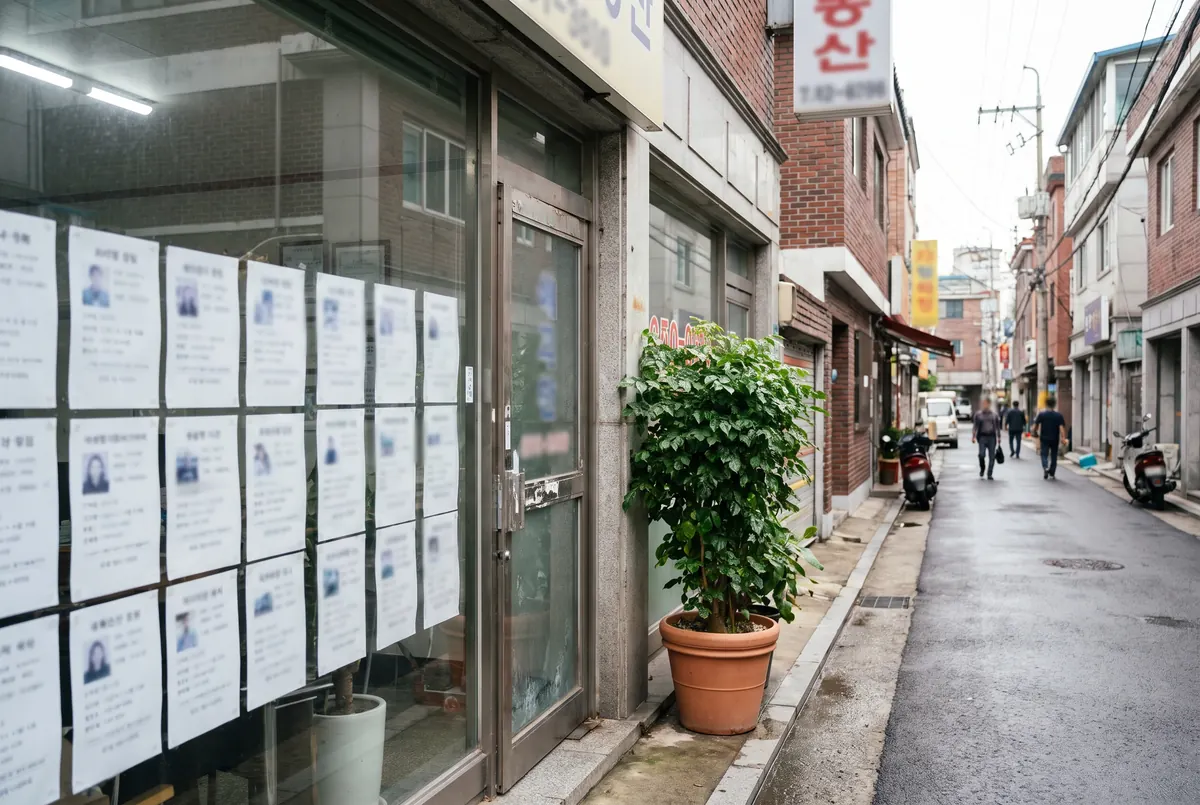
The "Street Walk" Method
After shortlisting online, physically walk the streets of your target neighbourhood and look for A4 paper listings posted in real estate agency windows. These are often the freshest and most accurate inventory. Walking into 3–4 local offices and talking to agents directly often yields better results than relying entirely on apps.
Foreigner-Friendly Platforms
Several platforms specialise in English-language support for foreign renters:
- Ziptoss (ziptoss.com): English listings, bilingual contract support
- KoreaHomeConnect (koreahomeconnect.net): Foreign-oriented consultation and listings
- FOHO (foreignerhome.com): Deposit insurance, bilingual support, foreigner-specific guidance
- Stay Korea (staykorea.org): Goshiwons, sharehouses, co-living for short-to-medium stays
6. Signing the Lease: A Step-by-Step Checklist
Before Viewing
- Set your budget: deposit + monthly rent + management fee + utilities + agent fee
- Confirm your ARC or visa status — most landlords require ARC or at minimum a long-term visa
- Have a Korean speaker available (friend, colleague, or paid interpreter) if you are not confident reading Korean
During the Viewing
- Check heating type — Korea uses ondol (floor heating) in most residential buildings; confirm it works
- Test air conditioning, stove burners, outlets, and hot water
- Check for mold (particularly in bathrooms and under sinks)
- Ask about natural light direction and noise levels
- Confirm if the address can be used for ARC registration (especially critical for officetels)
- Ask about internet provider options and installation fees
- Confirm pet policy in writing if you have or plan to get a pet
Before Signing
- Pull the 등기부등본 (building registry — see Section 7). Do this yourself the day of signing — not weeks earlier.
- Verify the landlord's name matches the owner listed in the registry
- Check for any mortgages, liens, or legal disputes listed in the registry
- Confirm the deposit amount is well within the landlord's equity (property value minus all debts)
- Review every line of the contract — have it explained clause by clause if needed
- Confirm the contract states: deposit amount, monthly rent, contract start/end dates, management fee responsibility, and any special agreements
The Contract Itself (임대차계약서)
A valid Korean lease contract must include:
- Names and resident numbers (or ARC numbers) of both parties
- Exact property address
- Deposit amount (보증금)
- Monthly rent (월세) if applicable
- Contract period (start and end dates)
- Management fee (관리비) — who pays, what it includes
- Special agreements (특약사항) — any verbal agreements must be written here
Never rely on verbal agreements. If the landlord promises something (e.g. "I'll replace the refrigerator before you move in"), it must be written in the special agreements section.
7. The Three Legal Steps That Protect Your Deposit
These three steps are the most important actions you take in any Korean rental. Foreigners who skip them have no legal protection if their landlord cannot return their deposit. Do all three as soon as you move in: the address report is due within 15 days, and the earlier your fixed-date stamp, the stronger your claim.
Step 1: Move-In Address Registration (전입신고)
Register your new address at your local 주민센터 (community centre) or online via Government24 (gov.kr). Bring your passport, ARC, and rental contract. This creates a legal record proving you live at the address.
For a registered foreigner, this same report is also your legally required change-of-address report to immigration — file it once, within 15 days of moving in, at the 주민센터, an immigration office, or online via HiKorea.
Step 2: Fixed Date Stamp (확정일자)
At the same 주민센터 visit (or at the local district court registry office), request a 확정일자 (hwakjeong-ilja) stamp on your rental contract. This is a date stamp proving your contract exists and giving your deposit legal priority over other creditors in the event of foreclosure or insolvency.
This is the single most important legal protection for your deposit. Without it, if your landlord goes bankrupt or the property is auctioned, you have no priority claim to your money. Cost: approximately ₩600.
Step 3: Lease Reporting (주택임대차 계약신고) — Fines Enforced from June 2025
Since June 2021, any new rental contract (outside rural counties) with a deposit over ₩60 million or monthly rent over ₩300,000 must be reported to the government within 30 days of signing. This can be done together with the 주민센터 address registration — bring your lease contract, passport, and ARC. Since June 1st, 2025, late or missing reports are fined ₩20,000–₩300,000 (up to ₩1,000,000 for false reports), and filing the report with your contract automatically gives it a 확정일자 (Step 2).
If your contract meets the threshold, ask the staff at your 주민센터 to help you with the 주택임대차 계약신고 when you register your address — they can process both at the same visit.
8. Deposit Scams: How to Avoid Them
Jeonse and wolse fraud is a documented problem in Korea. Government data showed over 40,900 officially recognised jeonse fraud victims by the end of August 2026 (about 550 of them foreign nationals), with those in their 20s and 30s making up the majority of cases. Foreigners are particularly vulnerable due to language barriers. Here is how to protect yourself.
The Most Common Scam Types
Concealed mortgage scam: The property has a large mortgage the landlord hides from you. When the landlord cannot repay the loan, the property is auctioned and the bank takes priority over your deposit.
Fake landlord scam: Someone poses as the owner and collects your deposit. By the time you discover the property is rented to someone else or owned by someone else, the money is gone.
Overvalued deposit scam: You pay a jeonse deposit that exceeds the property's actual value. If the landlord defaults, the auction proceeds cannot cover your full deposit.
"Ghost" property scam: The property doesn't exist or was already rented to another person.
How to Protect Yourself
Always pull the 등기부등본 (building registry):
The 등기부등본 is a government document showing who owns the property and every mortgage, lien, or legal claim against it. You can print a fresh copy at any 주민센터 for approximately ₩1,000, or online at iros.go.kr.
- Pull it the day you sign — not weeks earlier, as registrations change
- Check that the landlord's name matches the document exactly
- Check "갑구" (section A) for ownership details
- Check "을구" (section B) for mortgages and liens — the sum of all claims plus your deposit should be significantly less than the property value
Golden rules:
- Never pay a deposit in cash — always by bank transfer to the account in the property owner's name
- Never pay before seeing the contract signed by the actual registered owner
- If an agent pressures you to decide quickly or pay before paperwork is complete, walk away
- A property with a mortgage is not automatically disqualifying — but your deposit must be safe if the bank forecloses
Deposit Return Insurance (보증보험)
The Korea Housing & Urban Guarantee Corporation (HUG) and SGI Seoul Guarantee offer deposit return insurance (전세보증보험 / 보증보험). If enrolled, the insurer reimburses your deposit if your landlord cannot return it, then pursues the landlord for recovery.
- Premium: approximately 0.097–0.211% of the deposit amount per year at HUG (rates since March 31, 2025, depending on housing type, deposit size and the property's debt ratio)
- Both jeonse and wolse deposits can be insured
- A government program (run through local governments nationwide) refunds up to ₩400,000 of the premium for eligible low- and middle-income tenants with deposits of ₩300 million or less, but foreign nationals are not eligible
- You must apply before any financial dispute arises — apply soon after signing
For foreigners, several third-party services (FOHO, Foreigner Home Security Deposit Insurance launched November 2025) assist with the application process in English.
9. Moving In: Utilities, Internet & Address Registration
Setting Up Utilities
Korean utilities (electricity, gas, water) are billed to the resident, not the property. When you move in:
Electricity: Korea Electric Power Corporation (한전, KEPCO) — update the meter name at kepco.co.kr or call 123. Average monthly bill: ₩30,000–₩100,000 (spikes heavily in summer with air conditioning and winter with electric heating).
Gas: Depends on your local city gas provider (varies by region). Inform them of your move-in. Average monthly bill: ₩30,000–₩150,000 (peaks December–February for ondol floor heating).
Water: Usually billed through building management (관리비). Sometimes itemized separately.
Internet
Korea has some of the fastest and cheapest home internet in the world. Three main providers: KT (Korea Telecom), SK Broadband, and LG U+. Installation takes 1–3 business days and costs approximately ₩25,000–₩35,000/month for gigabit speeds. You will need your ARC to sign a contract.
Management Fee (관리비)
This monthly charge covers building common area cleaning, security guard services, elevator maintenance, and sometimes heating or garbage collection. The amount and what it covers varies widely by building — always ask exactly what your 관리비 includes before signing.
Address Registration — Critical for Foreigners
Within 15 days of moving in, you must report your new address at either of these (one report updates both your local and immigration records):
- Register your new address at your local 주민센터 (community centre)
- Update your address with immigration via HiKorea (hikorea.go.kr) or in person at the immigration office
Failure to update your address within 15 days is a legal violation and can result in fines. More importantly, your immigration and health insurance records will be tied to your old address, causing problems with renewals and services.
10. Your Rights as a Tenant (Housing Lease Protection Act)
Korea's Residential Lease Protection Act (주택임대차보호법) provides significant tenant protections — but only if you have completed the 전입신고 and 확정일자 (Steps 1 and 2 in Section 7).
Key Protections
Minimum tenancy duration: Under Korean law, even if your lease is written for less than 2 years, you are entitled to stay for a full 2 years unless you choose to leave earlier. A 1-year contract gives you the right to stay the second year at the same terms.
Rent increase cap: At contract renewal, a landlord can only increase the deposit or monthly rent by a maximum of 5% per renewal cycle. This prevents sudden large rent hikes.
Priority repayment (우선변제권): If you have completed both 전입신고 and 확정일자, you have priority over unsecured creditors for deposit repayment if the property is foreclosed.
Small deposit priority (최우선변제권): Tenants with very small deposits (below a threshold set by region — ₩165 million or less in Seoul under the standard in force since 21 February 2023 and still current in 2026; lower, older thresholds apply against mortgages registered before that date) who have registered their address have a protected priority claim even against the mortgage bank, up to a set amount (₩55 million in Seoul, capped at half the property's value). This protects the most vulnerable renters.
Forced eviction: A landlord cannot evict you before your contract ends without legal process. If the property is sold, the new owner must honour your lease.
Lease Renewal Rights
Before your contract ends, you have the right to request one automatic 2-year renewal at a maximum 5% rent increase. The landlord must notify you of any intention not to renew 6 months to 2 months before the contract end date. If they do not notify you within this window, the contract automatically renews on the same terms.
11. Moving Out & Getting Your Deposit Back
Before You Leave
- Give your landlord proper written notice — typically 1–2 months before contract end, though check your specific contract terms
- Schedule a joint move-out inspection with the landlord or their representative
- Document the condition of the property with photos and video
- Return all keys, access cards, and parking permits
- Clear all outstanding utility bills
Deposit Return Timeline
The landlord is legally required to return your deposit on the day you vacate (or as soon as the next tenant's deposit arrives, in practice). If they ask for "a little more time," your risk has increased.
If your landlord delays:
- Do not hand over the keys until you have the deposit — handing keys back before receiving your deposit eliminates your negotiating leverage.
- Apply for a Leasehold Right Registration Order (임차권 등기명령) at the local court. This preserves your priority rights even if you have already vacated.
- Contact the 주택 임대차 분쟁 조정위원회 (Housing Lease Dispute Mediation Committee) through the Korea Legal Aid Corporation (법률구조공단, 132) for free mediation.
- If the landlord has deposit return insurance through HUG, you can file a claim directly.
12. Short-Term & Temporary Options
If you are just arriving and need housing before you have an ARC or before you find a long-term rental:
| Option | Duration | Cost Range | Notes |
|---|---|---|---|
| Goshiwon | 2 weeks+ | ₩300–₩800K/month | Ideal landing pad; no ARC required |
| Sharehouse | 1–3 months+ | ₩400–₩900K/month | Community, foreigner-friendly |
| Airbnb | Days–weeks | Varies | Expensive long-term; use only initially |
| Serviced apartments | 1 month+ | ₩1.5M–₩4M/month | All-inclusive but expensive |
| Guest house | Days–weeks | ₩30,000–₩70,000/night | For very short initial stays |
13. Neighbourhood Guide: Seoul & Beyond
Seoul — Popular Areas for Foreigners
| Neighbourhood | Vibe | Best For |
|---|---|---|
| Mapo-gu / Hongdae | Creative, young, nightlife-heavy | Artists, young professionals, students |
| Mapo-gu / Yeonnam-dong | Trendy cafes, international community | Digital nomads, young expats |
| Seodaemun-gu / Sinchon | University area, affordable | Students near Yonsei, Sogang, Ewha |
| Yongsan-gu / Itaewon | International community, English-friendly | New arrivals, expats wanting English services |
| Seongdong-gu / Seongsu | Trendy, gentrifying, design-forward | Young professionals, higher budgets |
| Gangnam-gu | Business district, premium | Corporate expats, higher budgets |
| Songpa-gu / Jamsil | Family-friendly, green spaces | Families with children |
| Gwanak-gu / Sillim | Budget-friendly, student area | Budget-conscious renters near SNU |
Outside Seoul
| City | Character | Cost vs. Seoul |
|---|---|---|
| Busan | Coastal, slower pace, strong expat community | 20–35% lower |
| Incheon | Airport city, growing; Songdo is modern and international | 25–40% lower |
| Daegu | Central Korea, traditional, hot summers | 30–45% lower |
| Gwangju | Cultural hub of the southwest | 35–50% lower |
| Jeju Island | Island lifestyle, popular with digital nomads; costs rising | 10–25% lower but rising fast |
14. Glossary of Korean Housing Terms
| Korean | Pronunciation | English Meaning |
|---|---|---|
| 부동산 | budongsan | Real estate agency / agent |
| 공인중개사 | gongin junggyesa | Licensed real estate agent |
| 보증금 | bojeunggeum | Rental deposit |
| 월세 | wolse | Monthly rent |
| 전세 | jeonse | Lump-sum key-money lease |
| 반전세 | ban-jeonse | Hybrid deposit + partial rent |
| 관리비 | gwallibi | Monthly building management fee |
| 등기부등본 | deunggibu deungbon | Property registry / title document |
| 확정일자 | hwakjeong-ilja | Fixed date stamp (legal protection) |
| 전입신고 | jeonip singo | Move-in address registration |
| 계약서 | gyeyakseo | Contract / lease agreement |
| 계약금 | gyeyakgeum | Contract deposit (initial payment, usually 10% of deposit) |
| 잔금 | jangeun | Balance payment (remaining deposit at move-in) |
| 중개수수료 | jungge ssusuryeo | Agent commission fee |
| 주민센터 | jumin senteo | Community centre / district office |
| 아파트 | apateu | High-rise apartment complex |
| 빌라 | billa | Low-rise apartment building (3–5 floors) |
| 오피스텔 | opiseutel | Officetel (studio in mixed-use high-rise) |
| 원룸 | won-rum | One-room studio apartment |
| 고시원 | goshiwon | Micro-room boarding house |
| 쉐어하우스 | sheo hauseu | Sharehouse |
| 온돌 | ondol | Korean underfloor heating system |
| 특약사항 | teugyak sahang | Special agreements / addendum in a contract |
| 임대차 계약 | imdaecha gyeyak | Rental / lease contract |
| 임대인 | imdaein | Landlord |
| 임차인 | imchaein | Tenant |
| 보증보험 | bojeung boheom | Deposit return guarantee insurance |
Frequently asked questions
Do foreigners have to report their rental contract in Korea?
Yes, if the lease meets the threshold. In Korea's cities and the Seoul metropolitan area, any lease with a deposit over ₩60 million or monthly rent over ₩300,000 must be reported within 30 days of signing, by the landlord or tenant, at the local 주민센터 or online. Since June 2025, missing or late reports are fined ₩20,000–₩300,000. Filing the report with your contract also gives it a fixed-date stamp (확정일자) automatically.
How do I protect my rental deposit in Korea as a foreigner?
Check the property registry (등기부등본) on the day you sign to confirm the owner and any mortgages, and pay only into the registered owner's account. After moving in, report your address and get a fixed-date stamp (확정일자) on your contract as early as possible, ideally on move-in day, which gives your deposit legal priority. For extra protection, buy a deposit return guarantee (HUG, HF or SGI); foreigners with an ARC can apply to HUG.
Can foreigners get jeonse deposit insurance in Korea?
Yes. Registered foreigners can apply for HUG's jeonse deposit return guarantee like Koreans, for deposits up to ₩700 million in the Seoul metropolitan area or ₩500 million elsewhere, as long as less than half the lease term has passed. HUG premiums run about 0.097–0.211% of the deposit per year depending on housing type, deposit size and the property's debt ratio. The government premium refund of up to ₩400,000 is not available to foreign nationals.
How much is the real estate agent fee for renting in Korea?
Korean law caps brokerage fees for residential leases. For wolse, the transaction value is the deposit plus 100 times the monthly rent (70 times if that total is under ₩50 million). Under ₩50 million the cap is 0.5% (max ₩200,000); ₩50–100 million, 0.4% (max ₩300,000); ₩100–600 million, 0.3%; higher bands 0.4–0.6%. These are maximums, so fees can be negotiated; confirm the amount before signing.
How long do foreigners have to register a new address in Korea?
Registered foreigners must report a change of residence within 15 days of moving in. You can file it at the local 주민센터 (community centre), at an immigration office, or online through HiKorea; one report updates your records and also counts as the move-in registration (전입신고) that protects your deposit. Bring your ARC and lease contract. Missing the deadline can lead to a fine and delays your deposit protection.
What can I do if my landlord in Korea won't return my deposit?
If possible, keep the keys until you are paid. If you must move out first, apply to the local court for a leasehold registration order (임차권등기명령) so you keep your priority rights after leaving. Free mediation is available from the Housing Lease Dispute Mediation Committee through the Korea Legal Aid Corporation (132), and HUG's Jeonse Fraud Support Center (1533-8119) gives advice. If you hold a deposit return guarantee, file a claim with the guarantor.
Official sources
Rules, fees and deadlines change. Confirm the details with the official source before you act.
- HUG Jeonse Fraud Prevention Center (안심전세포털) khug.or.kr
- Easy Law — Small-deposit priority repayment (Ministry of Government Legislation) easylaw.go.kr
- Internet Registry Office (property registry, 등기부등본) iros.go.kr
- MOLIT Real Estate Transaction Management System (lease reporting) rtms.molit.go.kr
- HiKorea — immigration e-government (change of address) hikorea.go.kr
- Korea Legal Aid Corporation klac.or.kr
Disclaimer: Housing market conditions, price ranges, and legal requirements change regularly. The information on this page reflects best available data as of October 2026 (price ranges are 2025 estimates). Always verify current figures with licensed agents and official sources. For legal disputes, contact the Korea Legal Aid Corporation (132) or consult a licensed Korean attorney.
Last reviewed: · livinginkorea.org