
Key facts at a glance
- Korea's minimum wage for 2026 is ₩10,320 per hour (₩2,156,880 a month for 209 hours) for all workers regardless of nationality; it rises to ₩10,700 on 1 January 2027.
- Workers in Korea employed for at least 1 year (15+ hours a week) are owed severance of 30 days' average wages per year of service, payable within 14 days of leaving.
- In 2026 employees in Korea pay 4.75% of salary for National Pension, 3.595% for health insurance (plus long-term care) and 0.9% for employment insurance.
- Korea's National Pension contribution rose from 9% to 9.5% in January 2026 and will rise 0.5 percentage points a year until it reaches 13% in 2033, split equally with the employer.
- Korea's legal workweek is 40 hours plus up to 12 hours of overtime (52 hours total); at workplaces with 5+ employees, overtime, night and holiday work are paid at least 150%.
- Foreign workers in Korea get free labour counselling at 1350 (English and Chinese available) and from the Ministry of Employment and Labor's 24-hour AI chatbot in 34 languages at ai.moel.go.kr.
- Paternity leave in Korea is 20 working days (paid) since February 2025, and maternity leave is 90 days (120 days for multiple births).
Quick links: HiKorea visa portal · KOWORK job platform · Ministry of Employment & Labor · Labor Rights Hotline: 1350 (multilingual) · Immigration: 1345
Table of Contents
- Can You Work in Korea? The Visa-First Rule
- Work Visa Types — Full Overview
- How to Get a Work Visa: The Step-by-Step Process
- Teaching English in Korea: EPIK, GEPIK & Hagwons
- Finding a Job: Platforms & Job Fairs
- Korean Resumes (이력서) & Self-Introduction (자기소개서)
- Korean Labor Law: Your Rights as a Foreign Worker
- Minimum Wage, Overtime & Pay
- Severance Pay (퇴직금)
- Social Insurance: The Four Mandatory Programmes
- Changing Jobs on an E-Series Visa
- Freelancing & Self-Employment in Korea
- Workplace Culture in Korea
- If Things Go Wrong: Filing a Labor Complaint
- Glossary of Korean Employment Terms
1. Can You Work in Korea? The Visa-First Rule
Korea strictly ties the right to work to your visa status. You may only perform employment activities explicitly permitted by your current visa category. There is no "grace period" for starting work while waiting for paperwork, and working outside the scope of your visa — even briefly — is an immigration violation that can result in deportation and re-entry bans.
Key principle: Your visa comes first. Every other step — job offer, contract, salary — follows from having the correct visa category.
Who Can Work Without a Separate Work Visa?
Some visa holders already have broad employment rights:
| Visa | Employment Rights |
|---|---|
| F-2 (Long-term resident) | Any legal job, any employer |
| F-4 (Overseas Korean) | Any legal job except certain restricted occupations |
| F-5 (Permanent resident) | Any legal job |
| F-6 (Marriage migrant) | Any legal job |
| H-1 (Working holiday) | Part-time work up to 25 hours/week in permitted industries |
If you hold an E-series work visa, you may only work for the employer and in the job category listed on your visa. Changing employers requires immigration approval.
2. Work Visa Types — Full Overview
E-Series: Professional Work Visas
These are the primary work visas for professionals. All require employer sponsorship.
| Visa | Name | Who It's For | Key Requirements |
|---|---|---|---|
| E-1 | Professor | University-level teaching and research | Contract with an accredited higher education institution |
| E-2 | Foreign Language Instructor | Native English (and other language) teachers at schools, hagwons, universities | Bachelor's degree; clean criminal record; health check; contract with licensed institution |
| E-3 | Researcher | Scientists and researchers at government or private research institutes | Employment contract with a qualifying research institution |
| E-4 | Technical Instructor | Foreign technicians transferring skills to Korean workers | Technical expertise; employer sponsorship |
| E-5 | Professional | Licensed professionals (lawyers, engineers, accountants, doctors with Korean recognition) | Relevant professional licence or degree |
| E-6 | Arts & Entertainment | Performers, athletes, artists engaged commercially (concerts, sports, etc.) | Contract with a Korean organiser or sponsor |
| E-7 | Special Ability (Designated Activities) | Skilled professionals in roles designated by the Ministry of Justice — 67 professional, 10 semi-professional and 14 skilled occupations, plus the points-based E-7-4 track | Relevant degree or experience; employer sponsorship; role must be on the approved occupation list |
| E-9 | Non-professional Employment | Manufacturing, agriculture, fisheries, construction under the Employment Permit System (EPS) | Only available through the EPS programme from designated countries |
E-7 Visa — The Most Important for Skilled Professionals
The E-7 is the broadest professional work visa and the most commonly used by foreigners working in Korean companies outside of teaching. It covers four sub-categories:
- E-7-1: Managers and professionals (67 occupations — IT, finance, engineering, design, marketing, etc.)
- E-7-2: Office and service workers (10 occupations)
- E-7-3: Craft and related skilled workers (14 occupations as of May 2026)
- E-7-4: Skilled tradespersons (points-based system for former E-9/H-2 workers)
General requirements for E-7-1:
- Master's degree or higher in a related field, or
- Bachelor's degree plus 1+ year of relevant experience, or
- 5+ years of relevant professional experience (no degree required)
- Employer in Korea must demonstrate the role cannot be easily filled by a Korean national for some categories
Tip: If your annual remuneration exceeds 3x Korea's GNI per capita (approximately ₩150M+ in 2026, based on the ₩49.95M GNI figure immigration applies to E-7), most education and experience requirements can be waived.
D-10: Job Seeker Visa
For graduates of Korean universities (or eligible overseas universities) searching for employment in Korea. Valid for 6 months; can be used to stay legally while job hunting. D-10 holders cannot work freely but may do approved internships during the search period. Once you secure an offer, you convert to the appropriate E-series visa.
3. How to Get a Work Visa: The Step-by-Step Process
Most E-series work visas follow this process. It is largely employer-driven — your Korean employer initiates the process.
Step 1: Secure a Job Offer
Your Korean employer (or an authorized immigration agent) must be willing to sponsor your visa. Confirm your offer letter before beginning any immigration steps.
Step 2: Employer Applies for a CCVI
The employer applies for a Certificate of Confirmation of Visa Issuance (CCVI) at the local Korea Immigration Service office. They submit:
- Business registration certificate
- Tax payment certificates
- Financial statements
- Job description and salary confirmation
- Your qualifications (degree certificates, experience letters)
- Your passport copy and photo
This takes approximately 2–4 weeks.
Step 3: You Apply for the Visa Abroad
Once the CCVI is approved, the employer sends you the confirmation number. You then apply for the actual visa at the Korean embassy or consulate in your home country with:
- Completed visa application form
- Passport (6+ months validity)
- Passport photo
- CCVI confirmation number
- Degree and qualification certificates (apostilled if required)
- Criminal background check
- Health examination (required for E-2 and some other categories)
- Employment contract
Processing time: 5–10 business days at the embassy, after CCVI approval.
Step 4: Arrive and Register
After arriving in Korea, you must:
- Apply for your ARC (Residence Card) within 90 days at the immigration office
- E-2 holders must submit a medical check from a designated hospital (drug and syphilis tests; the HIV test was scrapped in July 2017)
- Report any change of address to immigration (or your local community service centre) within 15 days of moving in
Total Timeline
From job offer to legal work authorization: typically 5–10 weeks, depending on the visa type, documentation completeness, and immigration office caseload.
4. Teaching English in Korea: EPIK, GEPIK & Hagwons

Teaching English is the most common path for native English speakers to work in Korea. There are two main sectors: government programmes and private academies.
Government Programmes
EPIK (English Programme in Korea)
Run by the Ministry of Education. Places roughly 900–1,100 teachers in public schools across Korea a year in recent intakes.
- Salary: about ₩2,100,000–₩2,800,000/month depending on qualifications and experience (Fall 2026 scale; some provinces pay up to ₩3,000,000)
- Benefits: round-trip airfare, housing allowance (or provided housing), national health insurance, national pension, severance pay
- Contract: 1 year, renewable
- Requirements: Citizen of Australia, Canada, Ireland, New Zealand, South Africa, United Kingdom, or United States; bachelor's degree from the same country; clean criminal record; no TEFL required but recommended
- Apply at: epik.go.kr
GEPIK (Gyeonggi English Programme in Korea)
Gyeonggi Province (surrounding Seoul) no longer recruits separately — its public-school native English teachers are now hired through EPIK under a consignment arrangement.
SMOE (Seoul Metropolitan Office of Education)
The Seoul-specific equivalent of EPIK, for public schools within Seoul. Often more competitive due to location.
TaLK (Teach and Learn in Korea)
For recent graduates (not yet completed a 4-year degree or within 2 years of graduation) to teach in rural elementary schools. 15 hours/week teaching; lighter workload; included housing and stipend. Note: TaLK is no longer recruiting — its official site (talk.go.kr) is offline, so check with NIIED before relying on it.
Private Academies (Hagwons, 학원)
Hagwons are private education institutes (language, math, art, etc.). They employ the largest number of foreign English teachers in Korea.
Pros of hagwons:
- More positions available, faster hiring
- Often pay more than government programmes (experienced teachers can earn ₩2,500,000–₩3,500,000/month)
- More variety in location and hours
Cons of hagwons:
- Evening and weekend hours are common
- Quality varies enormously — research the school before signing
- Some unscrupulous hagwons have a history of contract disputes
Before signing a hagwon contract:
- Research the school on Dave's ESL Cafe Korea Job Board and expat forums
- Verify the school is a properly registered hagwon (학원 등록증) — only officially registered academies can legally sponsor an E-2 visa
- Confirm housing assistance, round-trip airfare, and severance are included in writing
- Check that the school's visa sponsorship record is clean — ask specifically about previous teachers
E-2 Visa Requirements
For all English teaching positions:
- Bachelor's degree (any field) from Australia, Canada, Ireland, New Zealand, South Africa, UK, or USA — degree must be from the same country as citizenship
- Clean national-level criminal background check (FBI for US citizens; must be apostilled)
- Medical examination including drug and syphilis tests, plus TB screening where required (done at a designated Korean hospital; the HIV test was scrapped in July 2017)
- Valid employment contract with a licensed institution
5. Finding a Job: Platforms & Job Fairs
Foreigner-Focused Job Platforms
| Platform | URL | Best For |
|---|---|---|
| KOWORK | kowork.kr/en | E-7 professional roles; visa-sponsored positions |
| XpatJobs | xpatjobs.com | English-language listings; teaching, remote, contract |
| linkedin.com | Global companies in Korea; English-heavy roles | |
| Craigslist Seoul | seoul.craigslist.org | Private tutoring, freelance, community roles |
| Dave's ESL Cafe | eslcafe.com/jobs/korea | Teaching positions; employer reviews |
| Gone2Korea | gone2korea.com | Teaching recruitment agency |
Korean Job Platforms (Korean-Language)
| Platform | Notes |
|---|---|
| Saramin (사람인) | saramin.co.kr — Korea's largest job portal; mostly Korean |
| JobKorea (잡코리아) | jobkorea.co.kr — another major Korean platform |
| Incruit | incruit.com |
| Work24 (고용24, formerly Worknet) | work24.go.kr — run by MOEL; includes public sector roles |
| Wanted | wanted.co.kr — startup and tech-heavy listings |
| Albamon / Alba Heaven | Part-time and hourly work; Korean-only |
Tip: Even if a platform is primarily Korean, many international companies post English-language listings on Korean platforms. Use Google Translate or Papago to navigate if needed.
Government Job Fairs
The Ministry of Employment and Labor (MOEL) regularly holds foreign worker job fairs in Seoul and other cities. These bring together Korean companies actively seeking foreign employees — particularly for E-7 roles. Check work24.go.kr or the Seoul Global Center for upcoming fair schedules.
Networking
Korean hiring culture places significant weight on personal introductions (인맥). Being introduced to a company through a mutual contact carries more weight than a cold application. Join expat professional networks, industry meetups (Meetup.com, Internations), and LinkedIn groups for your sector in Korea.
6. Korean Resumes (이력서) & Self-Introduction (자기소개서)
The Korean Resume (이력서)
The Korean resume format differs from Western CVs in several key ways.
Standard sections:
- Personal information (인적사항): Full name, date of birth, nationality, contact number, email, current address. Including a professional photo is standard practice for Korean companies (not required for international companies in Korea).
- Education (학력): Listed chronologically from earliest to most recent. Include elementary, middle, and high school as well as university. State degree, institution name, graduation year, and GPA if strong.
- Work experience (경력): Job title and employer only (brief). Reverse chronological order for most formats; chronological for the traditional Korean style.
- Language skills (어학): List any language certifications (TOPIK score, TOEIC score, IELTS, etc.) along with self-assessed level (native / advanced / intermediate / beginner).
- Certificates & licences (자격증): Any professional certifications, including the issuing body.
- Military service (병역): Required for Korean men; foreigners write N/A or leave blank.
For Korean companies (대기업, 중견기업): Submit in Korean where possible. Have a native Korean speaker proofread — machine translation reads as unprofessional. Many large Korean companies use a standardized online application system rather than a PDF resume.
For international companies and startups in Korea: English is generally accepted. A bilingual version (English section headings with some Korean content) can demonstrate cultural awareness.
The Self-Introduction Letter (자기소개서)
Most Korean companies — particularly large conglomerates and public institutions — require a 자기소개서 alongside the resume. This is not a Western-style cover letter. It is a structured personal essay, typically divided into 4 sections:
- Growth background (성장 과정): Your upbringing and formative experiences
- Personality strengths and weaknesses (성격의 장단점): Self-aware, specific examples
- Reason for applying (지원 동기): Why this company and this role specifically
- Future goals (입사 후 포부): What you plan to contribute
Format: Use formal Korean (격식체, ending in -습니다, never -요). Quantify achievements ("increased sales by 15%," not "worked on sales"). Length: 400–800 characters per section, depending on company guidelines.
For international companies, a standard English cover letter is usually appropriate.
What Korean Recruiters Look For
According to a 2025 KOWORK survey, 7 out of 10 Korean companies are currently hiring or planning to hire foreign employees. When evaluating foreign candidates, Korean companies commonly prioritize:
- Korean language ability (TOPIK Level 3+ is a practical threshold for most roles)
- Relevant degree and verifiable experience
- Demonstrated commitment to staying in Korea long-term
- Cultural understanding and adaptability
7. Korean Labor Law: Your Rights as a Foreign Worker
Korea's Labor Standards Act (근로기준법) applies to all workers in Korea regardless of nationality, visa type, or immigration status. Foreign workers have the same statutory protections as Korean employees. Even undocumented workers are entitled to certain basic labour rights including severance pay.
Written Employment Contract — Mandatory
All employers must provide a written employment contract before work begins. The contract must clearly state:
- Job duties and description
- Work location
- Salary and payment schedule
- Working hours and break times
- Paid leave entitlements
- Notice period for termination
- Severance pay terms
If your employer refuses to provide a written contract, this is a violation of the Labor Standards Act. You can file a complaint with the Ministry of Employment and Labor (see Section 14).
Working Hours
| Category | Legal Standard |
|---|---|
| Standard workweek | 40 hours (8 hours/day, 5 days/week) |
| Maximum overtime per week | 12 additional hours |
| Maximum workweek | 52 hours total |
| Rest between shifts | No general statutory minimum; 11 consecutive hours required only in special cases (e.g., transport and healthcare workers under Article 59, and some flexible-hours schemes) |
| Break (4-hour shift) | Minimum 30 minutes |
| Break (8-hour shift) | Minimum 1 hour |
Night work (10 PM–6 AM) and holiday work require additional compensation.
Annual Leave (연차)
| Service Duration | Annual Leave Entitlement |
|---|---|
| Less than 1 year | 1 day per month worked (maximum 11 days) |
| 1 year | 15 days |
| 3 years+ | 16 days (increases by 1 day every 2 additional years) |
| Maximum | 25 days |
Unused annual leave can generally be carried over or must be compensated in cash upon termination.
Other Leave
- Maternity leave: 90 days (120 days for multiple births); the first 60 days are paid by the employer, the remainder through Employment Insurance
- Paternity leave: 20 working days (expanded from 10 days as of February 2025), paid
- Parental childcare leave: Up to 1 year per parent (extendable to 1.5 years in certain cases); paid through Employment Insurance
- Sick leave: No statutory paid sick leave requirement in Korea (this is negotiated in individual contracts)
8. Minimum Wage, Overtime & Pay
Minimum Wage 2026
₩10,320 per hour — applicable to all workers regardless of nationality, employment type, or industry.
This translates to approximately:
- ₩2,156,880 per month (based on 209 hours: 40-hour week + 8 hours paid weekly holiday hours)
- ₩25,882,560 per year (based on 40-hour workweek)
The minimum wage is reviewed annually by the Minimum Wage Commission and typically takes effect from January 1st. The 2027 rate has been set at ₩10,700 per hour (₩2,236,300 per month based on 209 hours, +3.7%), effective 1 January 2027. Check the current rate before any contract negotiation.
Overtime Pay
Overtime is any work beyond 40 hours per week (with employee consent, up to 12 additional hours).
| Type of Work | Rate |
|---|---|
| Overtime (beyond 40 hrs/week) | 150% of regular hourly wage |
| Night work (10 PM – 6 AM) | 150% of regular hourly wage |
| Holiday/rest day work | 150% of regular hourly wage (+ additional if over 8 hours) |
Night work and overtime rates can stack. An employee working overtime at night is entitled to 200% of their regular wage.
Reading Your Payslip
Korean payslips (급여명세서) are legally required to be issued to all employees. They are typically in Korean. Key line items:
| Korean | English |
|---|---|
| 기본급 | Base salary |
| 시간외수당 | Overtime pay |
| 식대 | Meal allowance |
| 교통비 | Transportation allowance |
| 국민연금 | National Pension deduction |
| 건강보험 | Health Insurance deduction |
| 고용보험 | Employment Insurance deduction |
| 소득세 | Income tax |
| 지방소득세 | Local income tax |
| 실수령액 | Net take-home pay |
Request a bilingual payslip from your employer if you cannot read Korean — some larger and international companies provide these.
9. Severance Pay (퇴직금)
Korea's severance pay system is one of the most employee-friendly in Asia and often surprises new arrivals.
All employees who have worked for 1 year or more are entitled to severance pay, regardless of whether they resigned, were laid off, or were dismissed for cause. This applies to foreign workers on all visa types.
How Severance is Calculated
Severance = (Average daily wage) x 30 days x (years of service)
Where average daily wage = total wages earned in the last 3 months / 90 days.
Critically, "total wages" includes not just base salary but also all regular overtime pay, fixed allowances, and regular bonuses paid during those 3 months. Employers cannot calculate severance using base salary alone.
Example: An employee worked for 2 years with an average monthly income (base + overtime + fixed allowances) of ₩3,000,000.
- Average daily wage: (₩3,000,000 x 3) / 90 = ₩100,000
- Severance: ₩100,000 x 30 x 2 = ₩6,000,000
Payment Timeline
Severance must be paid within 14 days of termination. Late payment without a legitimate reason is a violation; from October 2025, employees can claim up to triple damages for deliberate wage delays.
DC Pension System
Some employers use the Defined Contribution (DC) pension system instead of accruing severance internally. Under this system, the employer deposits 1/12 of annual income (8.33%) into an individual pension account each year. At termination, the employee withdraws the total balance. Check your contract to understand which system your employer uses.
10. Social Insurance: The Four Mandatory Programmes
All employees working in Korea — including foreigners — must be enrolled in Korea's four major social insurance programmes. Both you and your employer pay contributions.
| Insurance | Korean | Purpose | Employee Rate (2026) | Employer Rate |
|---|---|---|---|---|
| National Pension (NP) | 국민연금 | Retirement benefits | 4.75% of gross salary (rising 0.5%p a year to 6.5% by 2033) | 4.75% |
| National Health Insurance (NHI) | 건강보험 | Medical coverage | ~3.595% of gross salary, plus long-term care insurance (13.14% of the health premium) | ~3.595% |
| Employment Insurance (EI) | 고용보험 | Unemployment benefits, parental leave | 0.9% | 1.15–1.75% |
| Workers' Compensation | 산재보험 | Work injury coverage | 0% (employee-free) | Varies by industry |
Notes for foreigners:
- National Pension: Korea has social security agreements in force with 41 countries (plus Quebec) as of 2026 — if your home country is on the list, you may be able to avoid dual contributions. Check with your Korean pension office (NPS, 1355).
- Health Insurance: Foreign employees are enrolled through their workplace from the start of employment. Since 16 July 2019, other foreign residents are automatically enrolled after 6 months of residence (F-5, F-6 and E-9 holders and D-2/D-4 students from entry). You cannot opt out (with limited exceptions for F-visa holders).
- Employment Insurance: Mandatory for F-2, F-5 and F-6 holders and automatically applied to E-9 and H-2 workers (unemployment and parental-leave benefits only if you apply). For E-1 to E-7, F-4 and most other work visas it is optional and only starts if you apply to join.
11. Changing Jobs on an E-Series Visa
E-series visas (E-1 through E-7) are employer-specific. Your visa lists your employer and job category. You cannot simply start working for a different employer without immigration approval.
Process for Changing Employers
- Secure a new job offer with a new employer
- Your new employer provides the documents immigration needs (new employment contract, business registration certificate and, in most cases, proof that your previous contract ended or a release letter)
- You file a workplace change (근무처 변경) with immigration: most E-1 to E-7 professionals report the new workplace within 15 days of the change, while some categories (e.g., E-6-2 and certain E-7 occupations) need permission (fee ₩120,000) before starting. A change of visa status (체류자격 변경) is only needed if the new job falls under a different visa category
- Your new employer registers as your visa sponsor
- You receive an updated ARC with the new employer's details
Important: You must continue working for your original employer during this process, or legally cease work until the new status is approved. If your category requires prior permission, working for the new employer before it is granted is an immigration violation; if it only requires a report, failing to report within 15 days is a violation.
Report Address and Employer Changes Within 15 Days
Any change in your employment (new employer, new workplace address) must be reported to immigration within 15 days via HiKorea or in person. Failure to report results in fines and deductions on the F-2 points system.
From E-Series to F-2 (Freedom from Employer Sponsorship)
After 3 years of continuous legal residence on qualifying E-series visas, you may be eligible for the F-2-7 points-based resident visa, which frees you from employer sponsorship entirely. See the Visa & Immigration guide for full details on the F-2-7 scoring system.
12. Freelancing & Self-Employment in Korea
Korea's standard work visa system is employer-centric — most work visas require an employer sponsor. Freelancing and self-employment are more complex but not impossible.
Options for Freelancers
F-2, F-4, F-5, F-6 visa holders can freelance and self-employ freely without any additional approval.
Corporate Investment (D-8) visa: For foreigners who want to register and operate their own business in Korea. Requires establishing a Korean legal entity, minimum capital investment (commonly ₩100M+ for certain categories), and demonstrated business viability.
Digital Nomad / Workation Visa (F-1-D): Allows remote freelancers employed by overseas clients to live and work in Korea legally — but only with foreign-source income. You cannot take Korean clients or local employment. See the Visa & Immigration guide for F-1-D details.
H-1 (Working Holiday): Limited freelance-style work is permitted within the allowed hour limits and job categories.
Business Registration as a Foreigner
Foreign nationals on eligible visas can register a business in Korea (사업자등록). The process involves:
- Applying at the local tax office (세무서) with your ARC, passport, and business plan
- Paying applicable taxes on Korean-sourced income
- Potentially enrolling in National Health Insurance as a self-employed individual
Consult a Korean accountant (공인회계사) or tax agent (세무사) familiar with foreign business registration before proceeding.
13. Workplace Culture in Korea
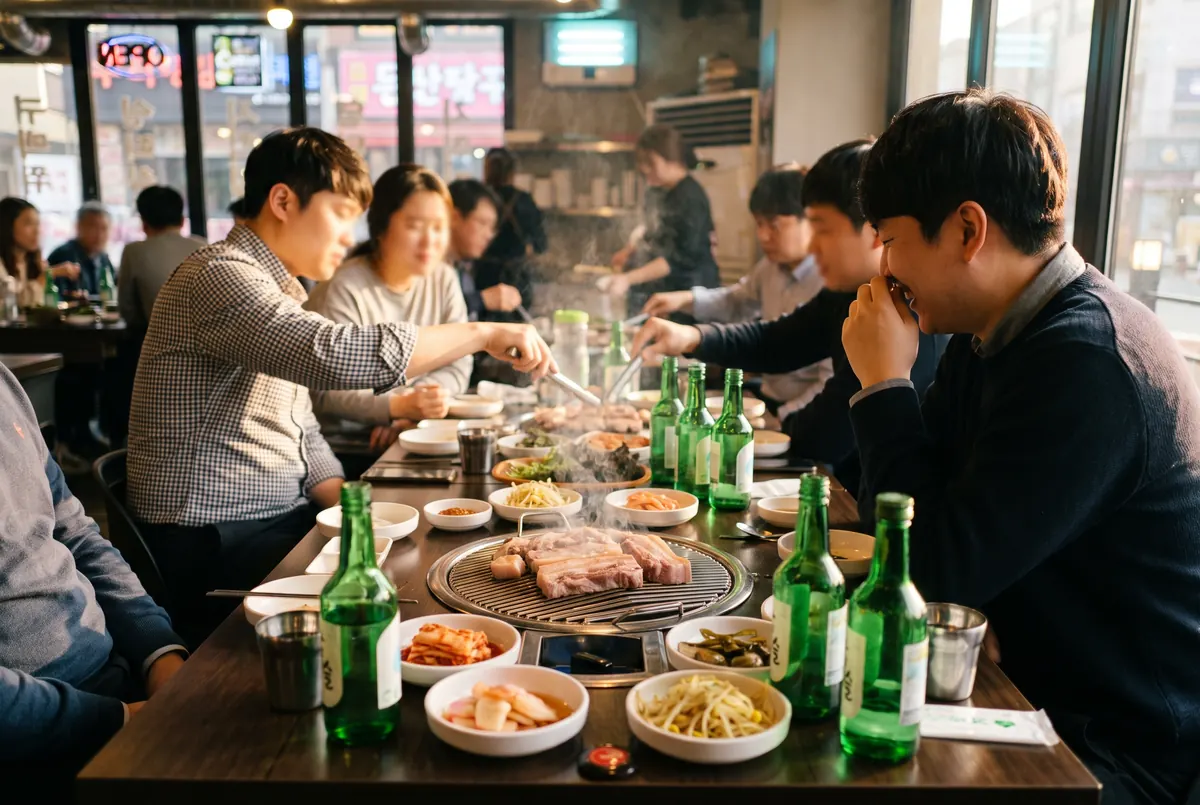
Understanding Korean workplace culture significantly improves your experience as a foreign employee. Korea's work environment reflects deeply Confucian values around hierarchy, group harmony, and long-term relationships.
Hierarchy and Titles
Korean workplaces are strongly hierarchical. Titles matter:
| Korean | English Equivalent |
|---|---|
| 대표 / 사장 | CEO / President |
| 이사 | Director |
| 부장 | General Manager / Department Head |
| 차장 | Deputy Manager |
| 과장 | Manager |
| 대리 | Assistant Manager |
| 주임 | Senior Staff |
| 사원 | Staff / Junior |
Address colleagues by their title + 님 (e.g., 김부장님 = Manager Kim), not by first name, unless explicitly invited to do otherwise. Using someone's first name without permission can be seen as disrespectful.
Work Hours Reality
Despite the 52-hour legal cap, workplace culture in some companies (particularly chaebols and traditional Korean companies) still involves long hours and an expectation of visible presence. Leaving before your boss can be uncomfortable in some environments. International companies and startups in Korea tend to have more flexible cultures.
Decision-Making and Approval Chains
Korea uses a 품의서 (pum-i-seo) system — a formal approval document that must travel up the chain before decisions are made. Be patient with decision timelines. Trying to bypass the approval chain, even with good intentions, can cause friction.
Communication Style
- Koreans often use indirect communication — especially when delivering bad news or disagreeing with a superior. Read context carefully.
- Nunchi (눈치) is the ability to read the room and understand unspoken expectations. Developing this skill helps enormously.
- Never publicly criticise a colleague or manager. Feedback is given privately, and even then, very diplomatically.
Drinking Culture
Work dinners (회식, hoesik) are common and often include drinking. While you are never legally obligated to drink, declining entirely can sometimes be socially awkward. It is generally acceptable to say you are driving, have health reasons, or simply nurse one drink. Foreign colleagues are usually given more latitude on this than Korean employees.
Gift-Giving
Small gifts for colleagues during major holidays (Chuseok, Lunar New Year) are common and appreciated. Practical gifts (gift sets of food, household items) are standard. Avoid giving four of anything — the number 4 (사) sounds like "death" in Korean.
14. If Things Go Wrong: Filing a Labor Complaint
Korea has robust enforcement mechanisms for labour violations. You have the right to file complaints even if you are a foreigner, and even if your visa status is complicated.
Common Violations
- Failure to pay wages on time (wage theft)
- Failure to provide or pay severance
- Failure to provide annual leave
- Working hours exceeding legal maximum
- No written employment contract
- Illegal deductions from wages
- Discrimination based on nationality
How to File a Complaint
Ministry of Employment and Labor (MOEL):
- Online: minwon.moel.go.kr
- In person: At any regional Employment and Labor Office (고용노동지청)
- Phone: 1350 (Korean; foreign-language counselling in English and Chinese via menu option 5 — use the AI chatbot below for other languages)
- AI labour law chatbot: ai.moel.go.kr — supports 34 languages, 24/7
Korea Legal Aid Corporation (법률구조공단):
- Phone: 132
- Free legal advice and representation for workers unable to afford private counsel
- Has English-speaking staff at major offices
Labor Relations Commission (노동위원회):
- For unfair dismissal cases
- Can order reinstatement and back pay if dismissal is ruled unlawful
Employer Cannot Retaliate
Retaliation against an employee for filing a labour complaint is illegal. If your employer threatens you with visa cancellation or termination for filing a complaint, document everything and contact the Labour Rights Hotline (1350) and your country's embassy.
15. Glossary of Korean Employment Terms
| Korean | Pronunciation | English Meaning |
|---|---|---|
| 이력서 | ireokseo | Resume / CV |
| 자기소개서 | jagi sogaeseo | Personal statement / cover letter |
| 취업비자 | chwieop bija | Work visa |
| 고용허가서 | goyong heogas-eo | Employment permit |
| 근로계약서 | geullo gyeyakseo | Employment contract |
| 급여 | geubyeo | Salary / wages |
| 최저임금 | choejeok imgeum | Minimum wage |
| 시간외수당 | sigangoe sudang | Overtime pay |
| 퇴직금 | toejik-geum | Severance pay |
| 연차 | yeoncha | Annual leave |
| 국민연금 | gukmin yeon-geum | National Pension |
| 건강보험 | geongang boheom | National Health Insurance |
| 고용보험 | goyong boheom | Employment Insurance |
| 산재보험 | sanjae boheom | Workers' Compensation Insurance |
| 4대보험 | 4-dae boheom | The four mandatory social insurance programmes |
| 회식 | hoesik | Work dinner / team meal (often social obligation) |
| 품의서 | pumiseo | Internal approval document / workflow |
| 부장 | bujang | Department head / general manager |
| 과장 | gwajang | Section manager |
| 대리 | daeri | Assistant manager / junior officer |
| 인사팀 | insa-tim | HR department |
| 노동부 | nodong-bu | Ministry of Employment and Labor (MOEL) |
| 노동위원회 | nodong wi-wonhoe | Labor Relations Commission |
| 법률구조공단 | beopnyul gujogongdan | Korea Legal Aid Corporation |
| 사업자등록 | sa-eobja deungnok | Business registration |
| 연말정산 | yeonmal jeongsan | Year-end tax settlement |
| 원천징수 | woncheon jingsu | Tax withholding at source |
Frequently asked questions
What is the minimum wage in Korea in 2026?
Korea's 2026 minimum wage is ₩10,320 per hour, or ₩2,156,880 a month for a standard 209-hour month (40 hours a week plus paid weekly holiday hours). It applies to every worker regardless of nationality or visa, including part-timers. The rate has been set at ₩10,700 per hour (₩2,236,300 a month) from 1 January 2027. Report underpayment to the Ministry of Employment and Labor on 1350.
How is severance pay calculated in Korea?
If you have worked at least 1 year for the same employer (averaging 15+ hours a week), you are owed severance of 30 days of average wages for each year of service. Average daily wage is your total pay for the last 3 months divided by the number of days, including regular overtime, fixed allowances and regular bonuses. It applies to foreigners on every visa and must be paid within 14 days of leaving.
How much is deducted from my salary in Korea in 2026?
In 2026 an employee in Korea pays 4.75% of salary for National Pension, 3.595% for National Health Insurance plus long-term care insurance (13.14% of the health premium), and 0.9% for Employment Insurance if covered. Income tax is withheld monthly, plus local income tax of 10% of the income tax. Your employer pays matching pension and health contributions, a larger employment-insurance share and all workers' compensation premiums.
Can I change jobs on an E-2 or E-7 visa in Korea?
Yes, but only through immigration. Changing employers within the same visa category is a workplace change (근무처 변경) under the Immigration Act: most E-1 to E-7 professionals report the new workplace within 15 days, while some categories, such as certain E-7 occupations, need permission (fee ₩120,000) before starting. Your new employer supplies the contract and business documents. If the new job falls under a different visa category, you need a change of status instead.
How do I report unpaid wages in Korea as a foreign worker?
File a wage complaint with the Ministry of Employment and Labor online or at your regional Employment and Labor Office, or call 1350 for advice. Foreigners can file even if their visa status is complicated, and the Korea Legal Aid Corporation (132) offers free help. Since 23 October 2025, workers can sue for up to three times the unpaid amount when an employer deliberately or habitually fails to pay wages.
Do foreign workers in Korea have to join Employment Insurance?
It depends on your visa. Employment Insurance is mandatory for F-2, F-5 and F-6 holders and applies automatically to E-9 and H-2 workers, although some benefits require an application. For E-1 to E-7 professionals, F-4 holders and most other work visas, coverage is optional and starts only if you apply. Covered employees pay 0.9% of salary, and coverage is required to claim unemployment benefits and paid parental leave.
Official sources
Rules, fees and deadlines change. Confirm the details with the official source before you act.
- Ministry of Employment and Labor (English) moel.go.kr
- Minimum Wage Commission minimumwage.go.kr
- National Pension Service (English) nps.or.kr
- National Health Insurance Service (English) nhis.or.kr
- Work24 – public job portal (formerly Worknet) work24.go.kr
- HiKorea – Korea Immigration Service portal hikorea.go.kr
Disclaimer: Korean labour law and immigration regulations are updated regularly. Information on this page reflects the best available data as of October 2026. Always verify current minimum wage rates, insurance contribution rates, and visa requirements with official sources: Ministry of Employment and Labor (moel.go.kr/english), Korea Immigration Service (1345), or a qualified labour attorney or immigration consultant.
Last reviewed: · livinginkorea.org