Key facts at a glance
- Korea has used international age (만 나이) for legal and administrative purposes since June 28, 2023, though people may still mention their older 'Korean age' casually.
- From 2026, Korea made Labour Day (May 1) an official public holiday and restored Constitution Day (July 17) as a public holiday.
- Seollal and Chuseok are Korea's biggest holidays, each a three-day break; in 2026 they fell on Feb 16-18 and Sept 24-26, and trains sell out weeks ahead.
- In Korea, when a national day, Buddha's Birthday, Labour Day, Children's Day or Christmas falls on a weekend, the next working day becomes a substitute holiday.
- Tipping is not customary in Korea; some higher-end hotels and restaurants add a service charge, and cash tips to servers may be refused.
- In Korea, give and receive money, business cards and drinks with both hands, and wait for the most senior person to start eating before you begin.
- Hangul, the Korean alphabet created by King Sejong in 1443, has 14 basic consonants and 10 basic vowels; most learners can read it after a few hours of study.
Table of Contents
- The Cultural Foundation: Confucian Hierarchy
- Language of Respect: Formal vs Informal Korean
- Social Etiquette: The Non-Negotiables
- Dining & Table Manners
- Drinking Culture (술 문화)
- Gift-Giving
- Workplace Culture
- Korean Holidays & Celebrations
- Understanding Nunchi (눈치)
- Culture Shock: Common Triggers & How to Navigate Them
- Learning Hangul: Start Here
- Essential Korean Phrases for Daily Life
- Dating & Relationships in Korea as a Foreigner
- Korean Pop Culture: K-Pop, K-Drama, Webtoon
- Taboos & Things to Avoid
1. The Cultural Foundation: Confucian Hierarchy
Nearly every unique aspect of Korean social life has roots in Confucianism, which shaped Korean society for over 600 years during the Joseon dynasty and remains deeply embedded today — even as Korea modernises rapidly.
The core Confucian values that show up in daily life:
- Age determines social role. Who is older is fundamental to every interaction. Koreans establish age in early conversation specifically to know how to treat each other.
- Hierarchy is not oppression — it's order. Respect flows upward; responsibility and care flow downward. A senior colleague looks out for juniors; juniors show deference to seniors.
- Collective harmony over individual expression. The group's cohesion matters. Public disagreement, embarrassment of others, or standing out negatively is avoided.
- Jeong (정): A deep, untranslatable concept of emotional connection, affection, and attachment that develops over time between people — and even between people and places. Relationships in Korea have more emotional weight and longevity than many Westerners expect.
This doesn't mean Korea is rigid. Gen Z and millennial Koreans are actively pushing back against many traditional hierarchies, particularly around work culture and gender roles. What you experience depends heavily on the setting — a startup in Hongdae feels very different from a large conglomerate.
2. Language of Respect: Formal vs Informal Korean
Korean has multiple speech levels — this is not just about vocabulary but entire grammatical structures. The two most important for foreigners:
존댓말 (Jondaemal) — Formal/Respectful speech
Used with elders, superiors, strangers, customers, and anyone you've just met. Sentences end in -습니다, -세요, -입니다.
반말 (Banmal) — Casual/Informal speech
Used with close friends of the same or younger age. Sentences end in shorter, simpler forms. Using banmal with someone you don't know well, or someone older, is considered rude.
As a foreigner learning Korean, always default to formal speech (존댓말) with anyone you meet. Koreans will be impressed and will usually invite you to speak more casually once comfort is established.
Addressing people by title rather than name is standard:
- 선생님 (seonsaengnim) — teacher (can be used respectfully for any professional)
- 교수님 (gyosunim) — professor
- 사장님 (sajangnim) — business owner / boss
- [Name] + 씨 (ssi) — respectful suffix for adults: "김지수씨" = "Ms./Mr. Kim Jisoo"
- [Name] + 님 (nim) — extra formal, used in service settings
4. Dining & Table Manners
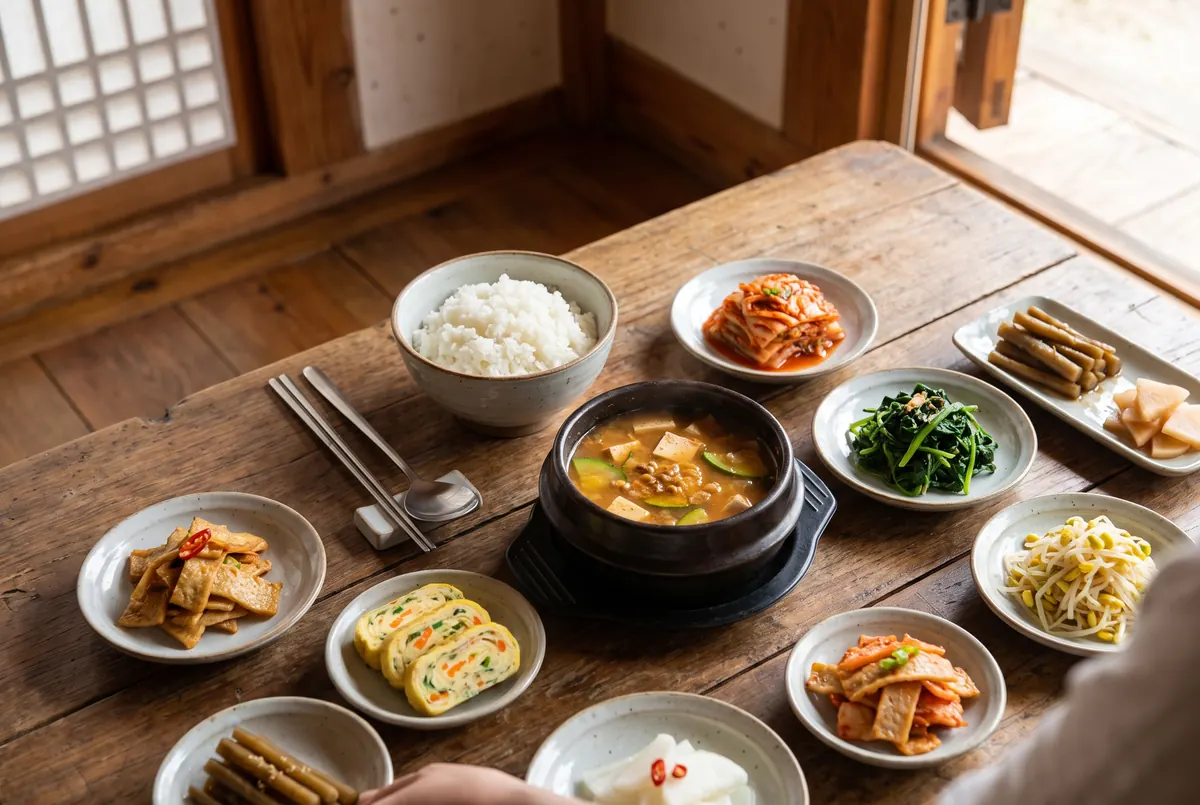
Communal dining is central to Korean social life. Many dishes are shared from the table's centre.
Key Rules
Wait for the most senior person to lift their spoon/chopsticks before starting to eat. This is the signal that the meal has begun. It is a form of respect, not just courtesy.
Do not hold your rice bowl up to eat from it. Korean dining convention keeps the bowl on the table and uses a spoon, unlike Japanese or Chinese styles where lifting is normal. Koreans use spoons for rice and soup, chopsticks for side dishes.
Do not stick chopsticks upright in rice. This mimics the incense offering at funerals and is considered very bad luck.
Do not pass food from chopstick to chopstick directly. Same funeral association (bones are handled this way in cremation ceremonies).
Two-handed eating: When using a spoon and chopsticks together, hold one in each hand — both are considered utensils, not a sign of bad manners.
Refilling others' glasses: It is common and polite to refill drinks for people sitting around you. Check others' cups before your own.
Splitting Bills (더치페이)
Traditionally, one person pays for the entire meal — often the most senior person or whoever invited the group. The custom of splitting bills (더치페이, Dutch pay) is more common among younger Koreans and in casual settings, but in formal contexts, expect one person to pay. If someone treats you to a meal, reciprocate next time.
Tipping
Tipping is not customary in Korea. Service charges are occasionally added at higher-end hotels and restaurants (listed separately on the bill). Offering cash tips to individual servers is unusual and may be refused.
5. Drinking Culture (술 문화)
Drinking is a significant part of Korean social life — at work dinners (회식, hoesik), friend gatherings, and celebrations.
The Rules of the Table
- Never pour your own drink in front of elders. Wait for someone to pour for you, then reciprocate by pouring for others.
- Hold your glass with both hands when receiving a pour.
- When drinking in front of someone older or senior, turn your head slightly away. A gesture of respect — you are not displaying your drinking openly to those above you.
- The most senior person at the table typically drinks first.
- An empty glass will be refilled almost immediately by those around you. If you want to slow down, leave some liquid in your glass.
If You Don't Drink
You are never obligated to drink alcohol. Practical ways to navigate this:
- Keep your glass partially full — people are less likely to refill what is not empty
- Hold the glass while others toast, then set it down — the gesture of participation matters more than the drinking
- Say "건강상 이유로 못 마셔요" (geongang sang iyuro mot mashyeoyo) — "I can't drink for health reasons"
- Offer to pour for others, which shifts attention away from your own glass
Koreans are generally respectful of health-based reasons; there is less pressure than many foreigners expect, though the social encouragement can be persistent.
Soju & the Korean Drinking Scene
Soju (소주) is the national spirit — clear, clean, 16–25% ABV, served in small shots. Inexpensive and ubiquitous. Often mixed with beer (somaek, soju + maekju) in Korea's famous "bomb shot" culture.
Makgeolli (막걸리) is a traditional rice wine, milky white, lightly carbonated, often served in bowls. Pairs beautifully with Korean pancakes (pajeon).
6. Gift-Giving
Gift-giving is integral to Korean social maintenance — for holidays, home visits, celebratory events, and expressions of gratitude.
When to Give Gifts
- Visiting someone's home for the first time
- Major holidays (Chuseok, Lunar New Year)
- Birthdays, weddings, births
- Starting a new job or as a thank-you to a mentor
- Returning from a trip abroad (기념품, souvenir)
What Makes a Good Gift
- Food gifts: High-quality food sets (fruit, meat, health supplements, honey, nuts) are the most common and always appropriate — especially at Chuseok and Lunar New Year. Department store gift sets are popular.
- Items from your home country: Something you cannot easily buy in Korea. Whiskies, specialty teas, local specialties from your country are always well-received.
- Cash: Very appropriate for weddings and births, given in white envelopes. Amount is governed by social convention — typically ₩50,000–₩100,000 for colleagues, more for close friends or family.
- Flowers: Fine for celebrations; avoid white flowers (associated with funerals).
What to Avoid
- Sets of 4 anything. The number 4 (사, sa) sounds identical to the Korean word for death. Four of any item is considered bad luck.
- Overly expensive gifts for casual relationships — creates a burden on the recipient to reciprocate equally
- Sharp objects (knives, scissors) — symbolically "cut" the relationship
- Writing names in red — traditionally used for names of the deceased
- Shoes — implies you want the person to walk away from you
Receiving a Gift
Do not open gifts immediately upon receiving them. Thank the giver warmly, set the gift aside, and open it later in private unless the giver explicitly asks you to open it now. Opening a gift immediately in front of the giver can feel like you are evaluating their choice.
7. Workplace Culture
Korean workplace culture varies enormously between traditional chaebols and modern startups. The following applies most strongly to traditional Korean companies.
Hierarchy in Action
- Decision-making flows downward. Ideas move up through channels; decisions come down. Bypass the chain of command at your peril.
- Visible presence matters. Leaving before your direct supervisor is uncomfortable in many Korean offices. The culture is shifting among younger workers, but pockets remain.
- Formal language is maintained professionally — even when you know someone well, addressing them by title in front of others shows respect.
Meeting Culture
- Business cards are exchanged formally — receive with both hands, look at the card attentively, and place it on the table in front of you during the meeting (not in your pocket immediately)
- In meetings, the most junior person often takes notes and the most senior may speak last (or first, setting tone)
- Disagreement is rarely expressed directly in meetings — pushback happens in private or through intermediaries
회식 (Hoesik) — Work Dinners
Attendance at team dinners is considered part of work culture, not optional socialising. These events are important for bonding and are where informal relationships are built. They typically involve 2–3 rounds at different venues (식당 → 호프 → 노래방 or similar). Foreigners get more latitude to leave early if needed.
Nunchi (눈치)
See Section 9 — this is especially important in the workplace.
8. Korean Holidays & Celebrations
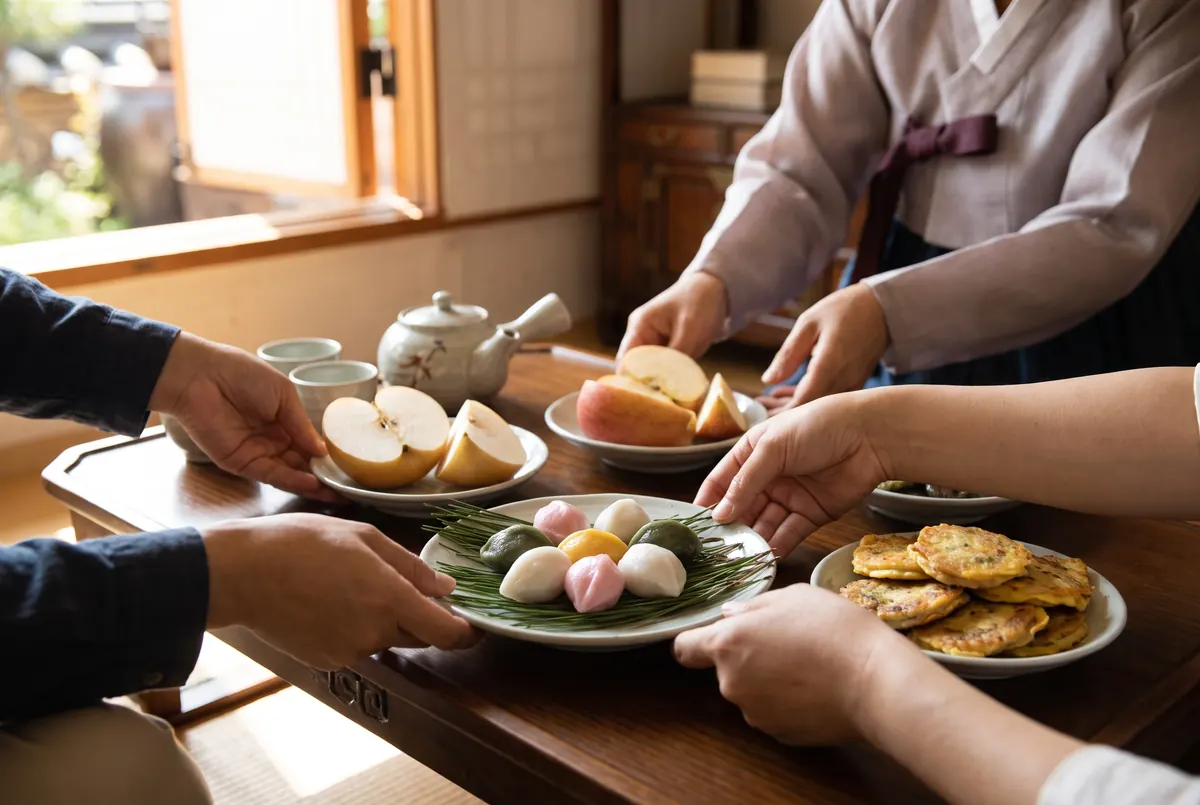
Public Holidays 2026
| Holiday | Date | Notes |
|---|---|---|
| New Year's Day | January 1 | |
| Lunar New Year (설날, Seollal) | Feb 16–18, 2026 | 3-day holiday; national travel surge |
| Independence Movement Day | March 1 | |
| Labour Day (노동절) | May 1 | Public holiday from 2026 |
| Children's Day | May 5 | |
| Buddha's Birthday | May 24, 2026 (substitute holiday May 25) | Sometimes overlaps with Children's Day |
| Local Election Day | June 3, 2026 | Nationwide election days are public holidays |
| Memorial Day | June 6 | |
| Constitution Day (제헌절) | July 17 | Public holiday again from 2026 |
| Liberation Day | August 15 | |
| National Foundation Day | October 3 | |
| Chuseok (추석, Korean Thanksgiving) | Sept 24–26, 2026 | 3-day holiday; national travel surge |
| Hangul Day | October 9 | Celebrates creation of the Korean alphabet |
| Christmas Day | December 25 |
Non-Public Cultural Occasions Worth Knowing
- White Day (March 14): Men give candy to women who gave them chocolate on Valentine's Day (February 14). Korea has commercialised both.
- Children's Day (May 5, also a public holiday): Families with children go out; parks and attractions are very crowded.
- Pepero Day (November 11): People give the biscuit sticks to friends and colleagues; commercialised but widely practiced.
- Christmas: Celebrated as a date/couple holiday more than a family holiday; restaurants and cinemas are busy.
9. Understanding Nunchi (눈치)
Nunchi (눈치) is one of the most important and untranslatable Korean cultural concepts. It refers to the ability to read the room — to sense others' feelings, unspoken expectations, and the social atmosphere, and to respond appropriately without being told.
In Korean society, good nunchi is considered a fundamental social skill. Someone with bad nunchi (눈치 없다) is perceived as tone-deaf, inconsiderate, or immature.
Practical examples of nunchi:
- Sensing that your host wants to end a visit even though they haven't said so, and leaving graciously
- Noticing that a colleague is stressed and not adding to their burden
- Detecting that your direct request is making someone uncomfortable and finding a different approach
- Reading that the group mood has shifted and adjusting your own behaviour accordingly
For foreigners, developing even basic nunchi awareness dramatically improves social interactions in Korea. You don't need to master it — but recognising that unspoken communication carries enormous weight will help you navigate situations that might otherwise feel confusing.
10. Culture Shock: Common Triggers & How to Navigate Them
"Rude" Questions About Personal Appearance
Koreans may comment on weight, skin, height, or appearance in ways that feel intrusive to Westerners. "You've gained weight" or "You look tired" are common observations — not intended as attacks. They reflect a culture of frank familiarity rather than malice. Understand the intent before reacting.
Directional vs Indirect Communication
Koreans often say "yes" (네, ne) to mean "I hear you" — not necessarily "I agree" or "I will do this." Vague answers to invitations often mean a polite no. Learn to read the context.
Pressure to Eat
Refusing food or drink is often met with persistent encouragement. "I'm full" or "I don't like that" may be taken as modesty. Be firm but warm if you genuinely cannot eat something.
Service Culture Differences
Korean restaurants and shops often have a "summon when ready" service culture. Calling "여기요!" (yeogi-yo! — "Over here!") or pressing the table buzzer is how you get attention. Waiting silently for a server to notice you can result in a long wait.
Speed and Efficiency Culture
Korea moves fast. Deliveries arrive in hours. Transactions complete in minutes. Waiting is minimised. This efficiency is wonderful — but it can also mean impatience is common when things slow down. Adjust expectations both ways.
11. Learning Hangul: Start Here
Hangul (한글) is Korea's phonetic writing system, created in 1443 by King Sejong. It is arguably the most logically designed writing system in the world — designed explicitly to be learnable quickly.
Most learners can read Hangul in 2–4 hours of focused study. Reading ≠ understanding, but being able to sound out Korean text opens enormous doors for navigation, menus, signs, and more.
The Structure
Hangul is made of consonants and vowels combined into syllable blocks. Each block = one syllable.
Basic consonants (초성, choseong — initial consonants):
| Letter | Sound | Letter | Sound |
|---|---|---|---|
| ㄱ | g/k | ㄴ | n |
| ㄷ | d/t | ㄹ | r/l |
| ㅁ | m | ㅂ | b/p |
| ㅅ | s | ㅇ | ng (silent at start) |
| ㅈ | j | ㅊ | ch |
| ㅋ | k | ㅌ | t |
| ㅍ | p | ㅎ | h |
| ㄲ | kk | ㄸ | tt |
| ㅃ | pp | ㅆ | ss |
| ㅉ | jj |
Basic vowels (중성, jungseong):
| Letter | Sound | Letter | Sound |
|---|---|---|---|
| ㅏ | a | ㅓ | eo (like "uh") |
| ㅗ | o | ㅜ | u (like "oo") |
| ㅡ | eu | ㅣ | i |
| ㅐ | ae | ㅔ | e |
| ㅑ | ya | ㅕ | yeo |
| ㅛ | yo | ㅠ | yu |
12. Essential Korean Phrases for Daily Life
Greetings & Basics
| Korean | Romanisation | Meaning |
|---|---|---|
| 안녕하세요 | annyeonghaseyo | Hello (formal) |
| 안녕히 가세요 | annyeonghi gaseyo | Goodbye (to someone leaving) |
| 안녕히 계세요 | annyeonghi gyeseyo | Goodbye (when you are leaving) |
| 감사합니다 | gamsahamnida | Thank you (formal) |
| 괜찮아요 | gwaenchanayo | It's okay / No problem |
| 죄송합니다 | joesonghamnida | I'm sorry (formal) |
| 실례합니다 | sillye hamnida | Excuse me |
| 네 / 아니요 | ne / aniyo | Yes / No |
Getting Help
| Korean | Romanisation | Meaning |
|---|---|---|
| 영어 할 수 있어요? | yeongeo hal su isseoyo? | Can you speak English? |
| 모르겠어요 | moreugesseoyo | I don't know / I'm not sure |
| 이것이 뭐예요? | igeosi mwoyeyo? | What is this? |
| 여기요! | yeogi-yo! | Over here! (calling a server) |
| 얼마예요? | eolmayeyo? | How much is it? |
| 이거 주세요 | igeo juseyo | Please give me this one |
| 화장실이 어디예요? | hwajangsiri eodiyeyo? | Where is the bathroom? |
Transport & Navigation
| Korean | Romanisation | Meaning |
|---|---|---|
| 여기서 내려 주세요 | yeogiseo naeryeo juseyo | Please drop me off here |
| [Destination]에 가주세요 | ...e gajuseyo | Please take me to [destination] |
| 지하철역이 어디예요? | jihacheolyeogi eodiyeyo? | Where is the subway station? |
Food & Ordering
| Korean | Romanisation | Meaning |
|---|---|---|
| 이거 하나 주세요 | igeo hana juseyo | One of this, please |
| 맵지 않게 해 주세요 | maepji ankke hae juseyo | Please make it not spicy |
| 채식주의자예요 | chaesikjuuijayeyo | I am vegetarian |
| 알레르기가 있어요 | allereugiga isseoyo | I have an allergy |
| 맛있어요! | massisseoyo! | It's delicious! |
| 계산해 주세요 | gyesan-hae juseyo | Bill please |
13. Dating & Relationships in Korea as a Foreigner
Dating culture in Korea has its own norms that differ from many Western contexts.
Couple culture is visible. Korean couples often wear matching outfits (커플룩, kepeul look), celebrate monthly anniversaries, and exchange couple rings. "100 Days" (100일) anniversaries are celebrated.
Meeting people: Dating apps (Tinder, Bumble, and Korean-specific apps like Amanda) are popular. Meeting through social circles and language exchange events is also common.
Family approval matters more in serious relationships in Korea than in many Western cultures. Meeting parents (부모님) is a significant step and often carries implicit discussion of marriage.
As a foreigner in a mixed relationship: Attitudes range widely. Urban Koreans, particularly younger generations, are generally open to international relationships. Rural areas and older generations may be more conservative. Prepare for curious questions from your partner's family about your background, career plans, and intentions.
LGBTQ+ life in Korea: Same-sex relationships are not legally recognised in Korea, and social acceptance — while growing rapidly among younger Koreans — is not yet mainstream. Seoul has an active LGBTQ+ community centred in Itaewon's "Homo Hill" area. The annual Seoul Queer Culture Festival (typically in June) is one of Asia's largest Pride events. Workplace discrimination and family pressure remain significant challenges for LGBTQ+ Koreans. Foreigners are generally left to navigate this independently.
14. Korean Pop Culture: K-Pop, K-Drama, Webtoon
Understanding Korean pop culture is increasingly relevant to understanding Korean society — and it is a genuine common ground between foreigners and young Koreans.
K-Pop: The industry is global, but most intense fan culture in Korea is local. If you follow K-Pop groups, you will have instant conversation starters with many Koreans. Fan meet-up culture, K-Pop cafe tours, idol birthdays, and fan events are part of Seoul's cultural landscape.
K-Drama: Korean television dramas are a primary shared cultural reference. Understanding references from popular dramas helps in conversations. Streaming via Netflix, Wavve, or Watcha gives access to a huge back catalogue. Common recurring themes: family, love, workplace rivalry, social class, redemption.
Webtoons: Korea is the global pioneer of vertical-scroll webcomics. Naver Webtoon and Kakao Webtoon have thousands of titles, many with English translations available via the WEBTOON app (formerly Line Webtoon). A growing number of popular K-Dramas originate as webtoon adaptations.
15. Taboos & Things to Avoid
| Situation | What to Avoid | Why |
|---|---|---|
| Meals | Sticking chopsticks upright in rice | Associated with ancestral offerings at funerals |
| Meals | Pouring your own drink in front of elders | Disrespectful; pouring is for others |
| Gifts | Sets of 4 items | Number 4 (사) = death |
| Writing | Writing names in red ink | Traditionally used for names of the deceased |
| Gifts | Shoes for someone you want to stay close to | Symbolically "sends them away" |
| Workplace | Publicly contradicting a senior colleague | Loss of face (체면, chemyeon) for them |
| Body | Crossing legs in front of a senior | Can read as dismissive or arrogant |
| Meeting someone | Using banmal (informal speech) too quickly | Presumptuous; always start formal |
| At the table | Starting to eat before the most senior person | Breach of dining hierarchy |
| General | Comparing Korea unfavourably to another country | Even if asked, be tactful |
Frequently asked questions
What are the public holidays in Korea in 2026?
Korea's 2026 public holidays: Jan 1; Seollal Feb 16-18; Independence Movement Day Mar 1 (substitute Mar 2); Labour Day May 1 (new from 2026); Children's Day May 5; Buddha's Birthday May 24 (substitute May 25); local elections June 3; Memorial Day June 6; Constitution Day July 17 (restored in 2026); Liberation Day Aug 15 (substitute Aug 17); Chuseok Sept 24-26; National Foundation Day Oct 3 (substitute Oct 5); Hangul Day Oct 9; Christmas Dec 25.
Does Korea still use Korean age?
Not officially. Since June 28, 2023, Korea has used international age (만 나이), counted from your birthday, for all legal and administrative purposes, so official documents match your passport age. The traditional counting age, in which everyone is 1 at birth and gains a year every January 1, is still used casually, so Koreans may describe themselves as one or two years older than their international age.
Do you tip in Korea?
No. Tipping is not customary in Korea, in restaurants, taxis, hair salons or for delivery riders. Some higher-end hotels and restaurants add a service charge, which is shown separately on the bill. Offering cash to a server can cause confusion and may be politely refused. A sincere 'gamsahamnida' (thank you), using both hands when handing over payment, is the usual way to show appreciation.
What are the basic table manners in Korea?
Wait for the most senior person to start eating before you begin. Keep your rice bowl on the table and eat rice and soup with a spoon, using chopsticks for side dishes. Never stick chopsticks upright in rice or pass food chopstick to chopstick, as both recall funeral rites. Do not pour your own drink in front of elders; pour for others, receive drinks with both hands and turn slightly away when drinking in front of seniors.
What gifts are appropriate in Korea?
Good gifts in Korea include quality food sets such as fruit, meat, honey or health supplements, especially at Seollal and Chuseok, and specialties from your home country. Cash in a white envelope is standard for weddings, typically ₩50,000-₩100,000 from colleagues. Avoid sets of four (4 sounds like 'death'), knives or scissors, shoes and writing names in red ink. Recipients usually open gifts later rather than in front of the giver.
How long does it take to learn to read Korean?
Hangul, the Korean alphabet created by King Sejong in 1443, was designed to be easy to learn. It has 14 basic consonants and 10 basic vowels that combine into syllable blocks, and most learners can sound out Korean text after 2-4 hours of focused study. Free courses from Talk To Me In Korean and the YouTube channel Korean Unnie teach the full alphabet.
Official sources
Rules, fees and deadlines change. Confirm the details with the official source before you act.
- Korea Law Information Center – Regulations on Public Holidays (관공서의 공휴일에 관한 규정) law.go.kr
- Korea Law Information Center – Act on Public Holidays (공휴일에 관한 법률) law.go.kr
- Korea Law Information Center – Framework Act on Administration (international age rule) law.go.kr
- Korea Tourism Organization – VisitKorea english.visitkorea.or.kr
- National Institute of Korean Language korean.go.kr
Last reviewed: · livinginkorea.org